Showing posts with label Samsung. Show all posts

Thursday, November 1, 2012

Apple v. Samsung Verdict of $1B Not Recognized in Apple Financials

Per Apple's 2012 10-K:

On August 24, 2012, a jury returned a verdict awarding the Company $1.05 billion in its lawsuit against Samsung Electronics and affiliated parties in the United States District Court, Northern District of California, San Jose Division. Because the award is subject to entry of final judgment and may be subject to appeal, the Company has not recognized the award in its consolidated financial statements for the year ended September 29, 2012. 

Tuesday, August 9, 2011

Bloomberg: Order Preventing Samsung Tablet Distribution in EU

According to Bloomberg:

Apple Inc. (AAPL) said it won a temporary order that prevents Samsung Electronics Co. Ltd. from distributing the Galaxy Tab 10.1 tablet computer in the European Union, except the Netherlands.

A district court in Dusseldorf, Germany, granted the injunction, according to the dpa-AFX news service, citing unidentified people involved in the court negotiations. Apple spokeswoman Kristin Huguet confirmed the report in a phone interview today.

I wonder if at some point, Samsung as a whole will decide it's simply more profitable to be Apple's supplier rather than its competitor.

Tuesday, May 3, 2011

Samsung v. Apple Fallout? TSMC and now Intel Pursuing Apple Foundry Work

From EETimes:

SAN JOSE, Calif. - At present, Samsung Electronics Co. Ltd. is making the Apple-designed A4 and A5 processors on a foundry basis for Apple Inc.

That could soon change. As reported, Apple and Taiwan Semiconductor Manufacturing Co. Ltd. (TSMC) have entered into a foundry relationship for the A5 and follow-on chips, sources said.

Now, according to an analyst, another player is pursuing Apple's foundry business: Intel Corp. Intel is already supplying x86-based processors for Apple's PC line. Intel is also dabbling in the foundry business and has recently struck a deal with Achronix Semiconductor Corp.

''Based on a number of inputs, we believe Intel is also vying for Apple's foundry business,'' said Gus Richard, an analyst with Piper Jaffray & Co., in a new report.

...

Samsung, as reported in earlier posts, is currently in a multi-jurisdictional IP battle with Apple, perhaps its largest customer.


Previous coverage:

Saturday, April 30, 2011

Samsung v. Apple: Calculating the Time (for a Re-exam)

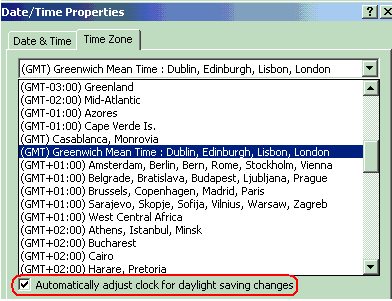
Samsung, in a 1998 patent application, claimed to have invented calculation of local time based on a network time, elapsed time, and offset from GMT for a selected city.  They now assert this patent against Apple.

Also among the patents asserted by Samsung against Apple is US7,069,055, Mobile telephone capable of displaying world time and method for controlling the same. The application was filed July 17, 1998.  The patent issued June 27, 2006.

The method embedded in the independent claims essentially requires: receiving a time signal, counting elapsed time, selecting a city for which GMT info is stored, and calculating and displaying the local time based on the other values.

It's not clear what might have been considered new about this in 1998.  GMT itself dates back to the 1800s.   According to a paper by ACM Fellow David L. Mills, the history of Network Time Protocol (NTP) traces back to 1979.  Selection of time zone by city, and storage of corresponding time relative to GMT seems to clearly go back to Windows 95, and I suspect much earlier.  While the title of the patent references a mobile telephone, the independent claims do not, so use in a mobile phone does not appear to have been the novel aspect.

Docview wss

Image from IBM support site.

Beyond the patent validity question, there is also the issue that modern computer systems like the iPhone use UTC, not GMT, and the two are technically different.

As with the stylus patent I discussed in a previous post, Samsung seems to be grasping a bit here for patents to assert.  While Apple's complaint against Samsung read as fairly devastating, Samsung's, so far, has been underwhelming.


Claim 4, for reference:

4. In an apparatus having a display and a memory for storing Greenwich mean time (GMT) information for each of a plurality of cities, a method for generating local time information, comprising the steps of:

  • receiving a reference time from a signal received from a remote system;
  • counting a time which elapses from said acquiring of said reference time;
  • selecting at least one of said plurality of cities;
  • automatically calculating a local time of said selected city based on the difference between the GMT of said selected city and the GMT of a present location of said apparatus, said reference time and said elapsed time; and
  • displaying said calculated local time.

Previous coverage:


Friday, April 29, 2011

Why Did Samsung Assert a Stylus Patent Against Apple?

Is a finger a stylus?  If the claim construction is based on the patent specification's definition... maybe.

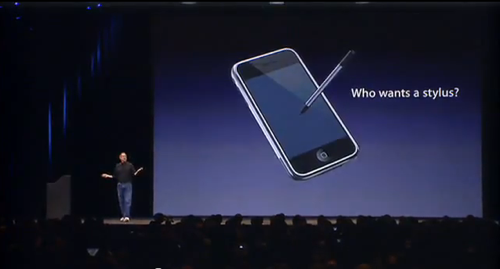
Among the patents asserted by Samsung in its April 27 suit against Apple is US6,292,179, Software keyboard system using trace of stylus on a touch screen and method.  This is initially quite puzzling, because, as Steve Jobs rather emphatically pointed out when introducing the iPhone in 2007, it does not use a stylus.
Screen shot 2011 04 29 at 6 40 16 PM

"Oh a stylus, right?  We're gonna use a stylus!  No.  No.  Who wants a stylus?  You have to get 'em and put 'em away, and you lose 'em. Yuck!  Nobody wants a stylus, so let's not use a stylus. " - Steve Jobs, Macworld Keynote, 2007

The complaint states, however:

Upon information and belief, in violation of 35 U.S.C. § 271, Apple is and has been directly infringing, contributing to the infringement of, and/or inducing others to infringe the '179 patent by making, using, selling, and/or offering to sell in the United States, or importing into the United States, products or processes that practice the inventions claimed in the '179 patent, including without limitation, the Apple iPhone 3G, the Apple iPhone 3GS, the Apple iPhone 4, the iPod Touch, the iPad, the iPad 3G, the iPad2, and the iPad 2 3G.

The '179 patent comprises four independent claims, one for the software keyboard system and three for related methods.  Independent system claim 1 contains the elements:

"a touch panel on said screen, generating a coordinate value in accordance with a position pressed by a stylus;"

and

"a controller controlling said display of said keyboard image, receiving said digital value for a trace of said stylus, and determining the position and direction of said trace;"

Independent method claims 7, 11, and 13 each contain the step:

"obtaining the trace of a stylus."

So, all of the claims require a stylus.  Samsung did not include Ten One Design or other iPhone stylus makers as defendants.  Where is the stylus coming from?

It would be hard to argue that a finger is within the plain meaning of the term "stylus."  However, a patent applicant is allowed to be his own lexicographer, within reason.  It appears that Samsung is trying to say they did just that, relying on language in the '179 specification to broaden the definition of stylus beyond its common meaning to include fingers:


"Here, "stylus" is used as a general term for any object which, when pressed onto a touch screen, can cause an input to a computer system or the like."  ('179 patent, column 1, lines 14-16)


It seems odd to consider a finger an "object," and therefore a "stylus" under the patent's definition.  However, that does seem to be Samsung's interpretation to justify asserting the patent.
 

NewImage

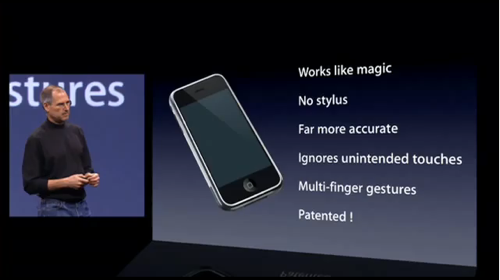
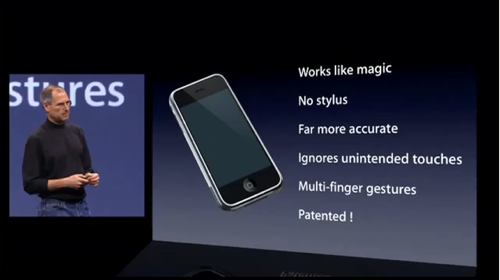
"No stylus" - Macworld 2007 Keynote

Previous coverage:

Thursday, April 28, 2011

Bloomberg: Samsung Broadens Patent Dispute Against Apple With U.S. Lawsuit

According to Bloomberg:


...

Apple is infringing 10 patents related to mobile phones, Samsung said in a lawsuit yesterday in federal court in San Jose, California. The Suwon, South Korea-based company, which sells the Galaxy smartphone and tablet, claims Apple is using Samsung’s inventions without paying.

The lawsuit intensifies a legal dispute that began when Cupertino, California-based Apple sued Samsung earlier this month, claiming the Galaxy products “slavishly” copied iPad and iPhone technology and design. Samsung, which is also a supplier of some Apple chips, retaliated last week with lawsuits in Seoul, Tokyo and Mannheim, Germany.

...


More to follow after I have reviewed the complaint.


Other coverage:

Friday, April 22, 2011

Samsung counter sues Apple over iPhone, iPad

As expected, Samsung counter sues Apple over iPhone, iPad:

Samsung said in a statement on Friday that Apple's iPhone and iPad infringe Samsung's 10 mobile technology patents and it called for Apple to stop infringing its technology and compensate the company.

[...]

Samsung said the suits, filed in South Korea, Japan and Germany, involved 10 alleged infringements of patents mainly involving power reduction during data transmission, 3G technology for reducing errors during data transmission, and wireless data communication technology.

(via Reuters)

I have to imagine there are people in Samsung's memory, SSD, display, and processor businesses who are not thrilled to see this escalate.

As Reuters also reports, Samsung shares were down 2.6% on this news after three days of gains:

Apple was Samsung's second-biggest client after Japan's Sony Corp last year, bringing in around 6.2 trillion Korean won ($5.7 billion) of sales, and is widely expected to become Samsung's top client this year.

With a market cap of $140B, a 2.6% drop is $3.64B in shareholder value.  Perhaps it won't just be the other business units that are upset about this litigation.


Other coverage:

Tuesday, April 19, 2011

Apple v. Samsung: The Multi-touch Patent

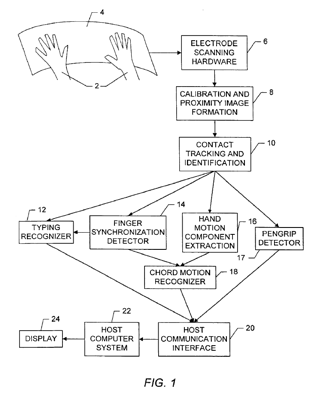
Apple's case against Samsung spans utility patents, design patents, trade dress, and trademarks.  Among the utility patents asserted by Apple against Samsung is US 7,812,828, Ellipse Fitting for Multi-Touch Surfaces.

The inventors are Wayne Westerman and John G. Elias, formerly of Fingerworks.

Though it issued on October 12, 2010, the patent actually dates back to a January 26, 1998 provisional application, and is a continuation of US 7,339,580, which is in turn a continuation of US 6,323,846.  (I suspect attorneys for Samsung are already verifying support in the original specification for the '828 claims being asserted by Apple.)

The patent is notable for listing over four pages of "References Cited."  This could become even more important depending on the outcome of Microsoft v. i4i at the Supreme Court, where Microsoft is arguing for a lowered bar for proving the defense of invalidity when art has not been considered by the USPTO.  In this case, a lot of art has been considered by the USPTO.

Claim 1 of the '828 patent is quite broad:


1. A method of processing input from a touch-sensitive surface, the method comprising:

receiving at least one proximity image representing a scan of a plurality of electrodes of the touch-sensitive surface;

segmenting each proximity image into one or more pixel groups that indicate significant proximity, each pixel group representing proximity of a distinguishable hand part or other touch object on or near the touch-sensitive surface; and

mathematically fitting an ellipse to at least one of the pixel groups.

While the images from the design patent claims will dominate the news stories, this is certainly the utility patent to watch.


Screen shot 2011 04 19 at 1 23 24 PM

Other coverage:


Flashback: Macworld 2007: "...and boy, have we patented it."

Steve Jobs at the Macworld 2007 introduction of the iPhone:

...and we have invented a new technology called multi-touch, which is phenomenal.  It works like magic.  You don't need a stylus.  It's far more accurate than any touch display that's ever been shipped.  It ignores unintended touches. It's super smart.  You can do multi-finger gestures on it, and boy, have we patented it.


Screen shot 2011 04 19 at 12 16 46 PM

Apple v. Samsung: Design Patents & Egyptian Goddess

The "ordinary observer" test would be key in the design patent portion of Apple's suit against Samsung.

In his post linking to Ina Fried's article on the new Apple v. Samsung case, DaringFireball's John Gruber asks:

That their products are shameless copies is hard to deny. But has anyone ever won a lawsuit based on copying stuff like this?

Apple's case is multi-pronged, with utility patent infringement, design patent infringement, trade dress, and trademark claims.  Regarding Gruber's question on "shameless copying," I think it is most interesting to first look at the design patent portion of the case.

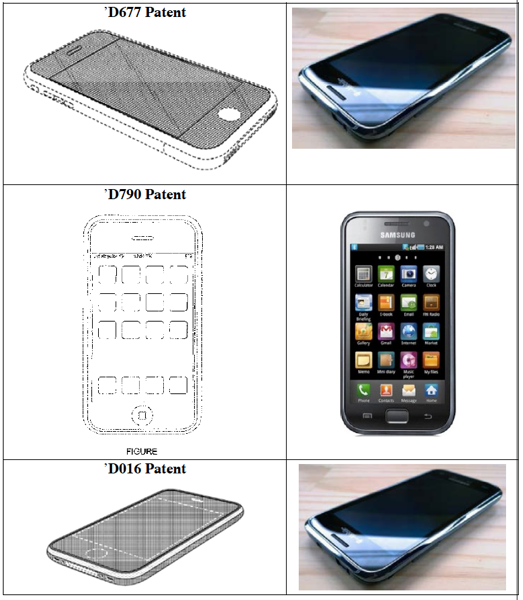
Apple is reportedly asserting three design patents:

  • U.S. Design Patent No. D618,677, "Electronic device"
  • U.S. Design Patent No. D627,790, "Graphical user interface for a display screen or portion thereof"
  • U.S. Design Patent No. D602,016, "Electronic device"

    Each appears to relate to the iPhone 3G/3GS style phone.

    Screen shot 2011 04 19 at 12 52 57 PM

    (image from Complaint, page 18)

    To determine whether a design patent is infringed, we need to look to the decision in the Federal Circuit's en banc rehearing of Egyptian Goddess, Inc. v. Swisa, Inc. (Fed. Cir. Sept. 22, 2008).  In this decision, the CAFC rejected the "point of novelty" test (i.e., "the accused device must appropriate the novelty in the patented device which distinguishes it from the prior art") and re-established the "ordinary observer" test as the exclusive test for determining infringement of a design patent:

    “if, in the eye of the ordinary observer, giving such attention as a purchaser usually gives, two designs are substantially the same, if the resemblance is such as to deceive such an observer, inducing him to purchase one supposing it to be the other, the first one patented is infringed by the other.” (Gorham Co. v. White, 81 U.S. 511, 528 (1871))

    As a patent attorney and close follower of all things Apple, I do not consider myself an "ordinary observer." However, I am quite sure that a Samsung Galaxy placed in front of someone like my mother would be quickly perceived as "an iPhone."  Anecdotal reports of pre-Verizon-iPhone sales people selling these Samsung devices as "just like an iPhone," if verifiable, also might not be helpful relative to the "purchase" prong of the test.

    The odds are that this case will not reach a jury and we will not find out whether a jury thinks these design patents are infringed.  Apple's complaint, however, paints a compelling picture.


    Other coverage:


    Monday, April 18, 2011

    WSJ: Apple Files Patent Suit Against Samsung Over Galaxy Line of Phones and Tablets

    According to the WSJ:

    In the latest patent suit to hit the smartphone industry, Apple is suing Samsung, alleging the Galaxy line of phones and tablets infringe on a number of the company’s patents.

    The suit, filed on Friday in U.S. District Court in Northern California, alleges patent and trademark infringement, as well as unfair competition. Apple is seeking injunctions, actual damages, punitive damages as well as a finding that the alleged infringement was willful.

    “It’s no coincidence that Samsung’s latest products look a lot like the iPhone and iPad, from the shape of the hardware to the user interface and even the packaging,” an Apple representative told Mobilized. “This kind of blatant copying is wrong, and we need to protect Apple’s intellectual property when companies steal our ideas.”

    [...]

    More to follow when the Complaint becomes available.  It's not on PACER as of this writing, so it appears that perhaps Apple seeded the story to WSJ and Reuters.


    Other coverage: