

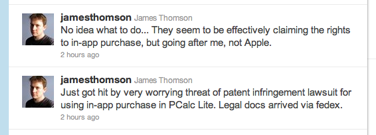
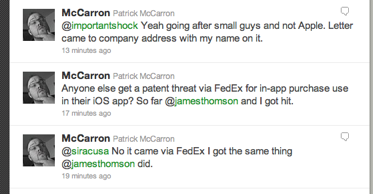
On May 13, 2011, developers of iOS apps began reporting receipt of demand letters via FedEx related to the use of in-app purchase in their apps. James Thomson, developer of DragThing and PCalc, and Patrick McCarron, developer of MobileAge apps, are amongst them.
Based on the small amount of information available, this appears to be another case where a patent holder is using a joint or contributory infringement theory combining the iOS developer's app, iOS, and Apple's processes. H-W Technologies filed suit against Apple and 31 others, mostly providers of apps, since the iPhone itself would not meet all of the limitations of the patent claims.
According to Gigaom:
The company behind the patent suit threats is apparently Lodsys, a patent holding firm which has held patent no. 7222078 (the one which is claimed to have been violated) since 2004. Lodsys cited the same patent, along with several others, when it filed suit against a number of major printer companies in early 2011, according to MacRumors.
US7,222,078 has a curious pedigree:
Continuation of application No. 09/370,663, filed on Aug. 6, 1999, now abandoned, which is a continuation of application No. 08/934,457, filed on Sep. 19, 1997, now Pat. No. 5,999,908, which is a continuation of application No. 08/243,638, filed on May 16, 1994, now abandoned, which is a continuation-in-part of application No. 07/926,333, filed on Aug. 6, 1992, now abandoned.
The patent was assigned from Daniel H. Abelow to Ferrara Ethereal, LLC on 12/10/2004, then to Webvention LLC 11/16/2009, then to Lodsys, LLC on 8/31/2010. [USPTO PAIR] Nilay Patel reports that Ferrara Ethereal is an Intellectual Ventures shell company.
Coincidentally, Sterne Kessler, a firm listed on many Apple patents, handled prosecution.
Claim 1 of US7,222,078:
1. A system comprising:
- units of a commodity that can be used by respective users in different locations,
- a user interface, which is part of each of the units of the commodity, configured to provide a medium for two-way local interaction between one of the users and the corresponding unit of the commodity, and further configured to elicit, from a user, information about the user's perception of the commodity,
- a memory within each of the units of the commodity capable of storing results of the two-way local interaction, the results including elicited information about user perception of the commodity,
- a communication element associated with each of the units of the commodity capable of carrying results of the two-way local interaction from each of the units of the commodity to a central location, and
- a component capable of managing the interactions of the users in different locations and collecting the results of the interactions at the central location.
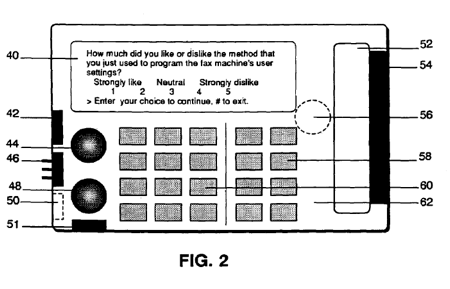
Figure 2 from US7,222,078. The relation to in-app purchase within an RPN calculator app is not quite apparent.
Note: This post was delayed due to the extended blogger.com outage
Related Coverage:

