Showing posts with label ITC. Show all posts

Thursday, June 30, 2011

X2Y Attenuators v. Intel, Apple, HP: ITC Investigation Initiated

In addition to the WDPA case filed on May 31, 2011, X2Y Attenuators also filed a complaint with the USITC. Today, the ITC announced initiation of an investigation:

From the USITC:

June 30, 2011

News Release 11-071

Inv. No. 337-TA-781

Contact: Peg O'Laughlin, 202-205-1819

USITC INSTITUTES SECTION 337 INVESTIGATION ON CERTAIN MICROPROCESSORS, COMPONENTS THEREOF, AND PRODUCTS CONTAINING SAME

The U.S. International Trade Commission (USITC) has voted to institute an investigation of certain microprocessors, components thereof, and products containing same. The products at issue in this investigation are microprocessors designed for improved power delivery.

The investigation is based on a complaint filed by X2Y Attenuators, LLC, of Erie, PA, on May 31, 2011. The complaint alleges violations of section 337 of the Tariff Act of 1930 in the importation into the United States and sale of certain microprocessors, components thereof, and products containing same that infringe patents asserted by the complainant. The complainant requests that the USITC issue an exclusion order and a cease and desist order.

The USITC has identified the following as respondents in this investigation:

  • Intel Corporation of Santa Clara, CA;
  • Componentes Intel de Costa Rica S.A. of Costa Rica;
  • Intel Malaysia Sdn. Bhd of Malaysia;
  • Intel (Philippines) of the Philippines;
  • Intel Products (Chengdu) Ltd. of China;
  • Intel Products (Shanghai) Ltd. of China;
  • Apple Inc. of Cupertino, CA; and
  • Hewlett-Packard Company of Palo Alto, CA.

By instituting this investigation (337-TA-781), the USITC has not yet made any decision on the merits of the case. The USITC's Chief Administrative Law Judge will assign the case to one of the USITC's six administrative law judges (ALJ), who will schedule and hold an evidentiary hearing. The ALJ will make an initial determination as to whether there is a violation of section 337; that initial determination is subject to review by the Commission.

The USITC will make a final determination in the investigation at the earliest practicable time. Within 45 days after institution of the investigation, the USITC will set a target date for completing the investigation. USITC remedial orders in section 337 cases are effective when issued and become final 60 days after issuance unless disapproved for policy reasons by the U.S. Trade Representative within that 60-day period.

Related Posts:

Reporting Patent Cases is Hard

Patent matters are tough to report. Most outlets get things wrong. Take what you read with a grain of salt.

As mentioned in my previous post, the U.S. International Trade Commission gave notice today of a fairly intricate set of determinations in an investigation involving Kodak, Apple, and RIM. As is invariably the case with patent matters, the details of the determinations are being misreported.

This is not surprising. These are complex matters both procedurally and technically. However, it's important that readers know that what they are reading is not always correct. I'll pick out a few such inaccuracies from today's articles to demonstrate.

First, from the AP:

The federal agency did find limited patent infringement. It also sent some matters back to the judge for further review, and Kodak could still prevail in the remaining claims.

The Commission did not find "limited patent infringement." The Commission found that the accused products "infringed" or "practiced" certain limitations of the one patent claim at issue, but the Commission did not itself render an infringement determination. The question of infringement is remanded.

Also from the AP:

The commission also found that Apple and RIM infringed on a patent related to "initiating capture of a still image while previewing a motion image." ...

The commission ruled that Apple and RIM did infringe a Kodak patent under the commission's revised definition of "at least three different colors."

Again, there was no determination by the Commission of infringement announced today, and there is only one patent, and one claim of that patent, at issue. The Commission modified constructions of claim terms and remanded the matter.

From TUAW:

However, two other claims have been restructured by the ITC, siding with Kodak on one claim and not making a determination on a third. The entire case is being sent back to lower courts for further review, giving Eastman Kodak Co. a remote possibility of prevailing with the other claims.

Multiple claims were not "restructured." There is only one patent claim at issue in the investigation. The Commission modified the constructions of terms within multiple limitations of that one claim. The case is also not being sent back to "lower courts." The matter is remanded to the administrative law judge at the ITC.

From AppleInsider:

The commission did however rule that Apple and RIM were guilty of infringing on a Kodak patent related to "initiating capture of a still image while previewing a motion image," and another under the commission's revised definition of "at least three different colors."

Again, the Commission made no such ruling. The Commission found that under the modified constructions, the accused products meet some of the claim limitations. No finding was made regarding overall infringement of that patent claim.


Patent cases are very tough to report accurately, especially for a general tech reporter or blogger without a legal background. If you really are interested in patent issues, however, consider taking the extra time and look to more legally-oriented sources who might have a firmer grasp on the subject matter and terminology. You might find that things make more sense.


Related Posts:

Kodak v. Apple/RIM @ ITC: Reconstructed & Remanded

Chief ALJ's claim constructions modified. Invalidity to be revisited. New target date is August 30.

The US International Trade Commission today announced its determination to "affirm in part, reverse in part, and remand in part, the final initial determination of the administrative law judge" in investigation 337-773 initiated by Kodak against Apple and RIM. The key elements of the notice were the Commission's announcement of modifications of the constructions of multiple claim terms important to the ALJ's findings of non-infringement. The matter is remanded to the ALJ so the issues of infringement and invalidity can be revisited under the new constructions. The new target date is August 30.

Kodak shares ended after-hours trading down nearly 15% at $3.05, a market cap decline of over $142M.

Kodak filed its complaint against Apple and RIM with the ITC on January 14, 2010. The ITC issued a Notice of Investigation on February 17, 2010. The investigation centered around claim 15 of Kodak's US Patent 6,292,218 and its applicability to Apple's iPhone 3G, 3GS, and 4, and a variety of RIM devices.

Chief ALJ Luckern's Final Initial Determination was issued January 24, 2011 with a finding that claim 15 is invalid as obvious, and with findings of non-infringement for all of the accused Apple and RIM devices.

To "win," Kodak needed the full commission to reverse both the invalidity -and- non-infringement findings from the Final ID. The full commission did neither, but did modify the claim constructions chosen by the ALJ at the Markman stage such that the non-infringement finding is weakened, particularly with respect to the iPhone 3G and RIM devices. The Commission did not itself address the invalidity finding, but left it to be revisited on remand using the new claim constructions.

Kodak CEO Antonio Perez set expectations of revenue from Apple and RIM similar to the nearly $1B extracted from LG and Samsung when Kodak settled the separate 337-663 investigation.

I will be able to provide opinion and analysis after the conclusion of the investigation.


Related Posts:


Thursday, June 23, 2011

Kodak v. Apple/RIM @ ITC: Extended by a Week

New target date is June 30.

The US International Trade Commission announced today a one week extension of the target date in the review of Chief ALJ Luckern's Final Initial Determination in investigation 337-703.

Kodak filed its complaint against Apple and RIM with the ITC on January 14, 2010. The ITC issued a Notice of Investigation on February 17, 2010. The investigation centered around claim 15 of Kodak's US Patent 6,292,218 and its applicability to Apple's iPhone 3G, 3GS, and 4, and a variety of RIM devices.

Chief ALJ Luckern's Final Initial Determination was issued January 24, 2011 with a finding that claim 15 is invalid as obvious, and with findings of non-infringement for all of the accused Apple and RIM devices.

To "win," Kodak will need the full commission to reverse both the invalidity -and- non-infringement findings from the Final ID. Reversal of the invalidity finding would require successful challenges to multiple invalidating combinations of art. Reversal of the non-infringement findings would require modification of the Chief ALJ's constructions of multiple claim terms.

Kodak CEO Antonio Perez set expectations of revenue from Apple and RIM similar to the nearly $1B extracted from LG and Samsung when Kodak settled the separate 337-663 investigation.


Related Posts:

Tuesday, June 14, 2011

Nokia v. Apple: Settled (for now)

According to Bloomberg:

Nokia Oyj (NOK1V) won an almost two-year patent struggle against Apple Inc. (AAPL), as the world’s two largest mobile-phone makers settled litigation in a deal that awards a one-off payment and royalties to the Finnish handset maker.

Nokia rose as much as 4.1 percent in Helsinki trading. The agreement will bolster the Devices & Services unit’s second- quarter profitability, Espoo, Finland-based Nokia said in a statement today. The details of the contract, under which Apple will pay Nokia an undisclosed sum and royalties for the term of the agreement, are confidential, the Finnish company said.

...

A critical point going unreported is whether Nokia received a cross-license to Apple's patents that will cover them as they devolve into a hardware supplier and distribution channel for Microsoft. Whether Microsoft is licensed may now be more important than whether Nokia is licensed. (SEE UPDATE BELOW)

While this is positive news for Nokia, the rumored amount of the settlement is unlikely to make up for Nokia's plunging revenues even for a quarter. At the time of this writing, Nokia shares are still well below their immediate post-warning level.

Update via telegraph.co.uk:

In a statement, Apple said "Apple and Nokia have agreed to drop all of our current lawsuits and enter into a license covering some of each others' patents, but not the majority of the innovations that make the iPhone unique. We're glad to put this behind us and get back to focusing on our respective businesses."

This will not be the end of Apple and Nokia's patent battles.


Previous coverage:

Friday, May 27, 2011

Nokia v. Apple @ ITC: Full Commission Review in 337-701

Nokia has been granted Full Commission review of a narrow portion of the ALJ's Final Initial Determination in the 337-701 investigation of Apple.  The investigation originally involved seven patents.  Matters related to only two will be reviewed. According to the Commission Notice:


On March 25, 2011, the ALJ issued his final ID, finding no violation of section 337 by Respondents with respect to any of the asserted claims of the asserted patents. ... Regarding the ’181 patent, the ALJ found that the accused products do not infringe its asserted claims. The ALJ also found that none of the cited references anticipated or rendered obvious the asserted claims. With respect to the ’256 patent, the ALJ found that the accused products failed to literally infringe the asserted claims and failed to infringe under the doctrine of equivalents. The ALJ also found that the asserted claims were not invalid for obviousness and were not rendered unenforceable due to inequitable conduct. ...The ALJ concluded that an industry exists within the United States that practices the ’789 patent but that a domestic industry does not exist with respect to the ’091 patent, the ’181 patent and the ’256 patent as required by 19 U.S.C. § 1337(a)(2) and (3).

...

Having examined the record of this investigation, including the ALJ’s final ID, the petitions for review, and the responses thereto, the Commission has determined to review the final ID in part. Specifically, the Commission has determined to review the findings related to the ’181 patent and the ’256 patent. The Commission has determined not to review any issues related to the ’957 patent, the ’091 patent, and the ’789 patent, and terminates those patents from the investigation.

(emphasis added)


Thus, Nokia would need the Full Commission to overturn the ALJ's findings on infringement and domestic industry to truly prevail.  The Commission's questions to the parties relate primarily to construction of "acoustic cavity" in the '181 and "integrated mobile terminal processor" in the '256.

Nokia and Apple have been busy at the ITC.  On April 26, 2011, Nokia's request for a USITC investigation based in part upon PalmPilot sync patents was granted.  Nokia is also the respondent in the 337-704 and 337-710 investigations initiated by Apple.

Susan Decker at Bloomberg provides background here.


Previous coverage:

Monday, May 16, 2011

Ogma v. Activision, et al.: ITC Initiates Investigation, Apple Already Out.

The USITC announced on Friday, May 13, 2011 that it will institute an investigation based upon Ogma, LLC's complaint of infringement of its '947 sound effects and '427 screen aspect ratio patents against over thirty entities.

It appears that Apple was dropped as a respondent in the unpublished April 26, 2011 amended complaint, as it does not appear in the announcement of the investigation.  Seiko Epson, Epson, HTC, Motorola Mobility, Sanyo and Sharp also have disappeared.

Even with Apple no longer involved, I may still check in on this investigation periodically to see how the '427 fares against the prior art.  I suspect it will not do well.  The ITC case should also provide useful guidance for Apple in the still pending cases (2-11-cv-00166 and 2-11-cv-00168) in Marshall, TX, if Apple remains as a defendant.  Joint Motions to Dismiss the '947 cases against Motorola Mobility and RIM have already been filed and granted.


Previous Coverage:

Friday, May 13, 2011

Apple v. Kodak @ ITC: Initial Determination

On May 12, 2011, Administrative Law Judge of the USITC Robert K. Rogers, Jr., issued an Initial Determination in investigation 337-717.  The investigation involves two Apple patents, U.S. Pat. No. 6,031,964 and U.S. Pat. No. RE38,911, and alleged infringement by Kodak.

The initial determination was not in Apple's favor.  While there is not a public version of the Initial Determination yet available, the Conclusions of Law have been made public.  The key findings are:

  • An industry does not exist in the United States that exploits U.S. Pat. No. 6,031,964, as required by 19 U.S.C. § 1337(a)(2).
  • Claims 1, 3, 5, 7, and 8 of U.S. Pat. No. 6,031,964 are not invalid.
  • The accused Kodak products do not infringe claims 1, 3, 5, 7, and 8 of U.S. Pat. No. 6,031,964.
  • There is no violation of 19 U.S.C. § 1337(a)(l) with respect to U.S. Pat. No. 6,031,964.

and:

  • An industry exists in the United States that exploits U.S. Pat. No. RE38,911, as required by 19 U.S.C. § 1337(a)(2).
  • Claims 15, 27, 30, and 38 of U.S. Pat. No. RE38,911 are invalid pursuant to 35 U.S.C. § 102.
  • The accused Kodak: products do not infringe claims 15,27,30, and 38 of U.S. Pat. No. RE38,911.
  • There is no violation of 19 U.S.C. § 1337(a)(l) with respect to U.S. Pat. No. RE38,911.

From Bloomberg:

“We’re pleased by today’s ruling and we are looking forward to the full ITC commission’s ruling in our case against Apple and RIM, which is expected in late June,” David Lanzillo, a spokesman for Kodak, said in a statement.

The investigation against Apple is number 337-703, with a target date for completion of June 23.


Note: This post was delayed due to the extended blogger.com outage.


Previous coverage:

Friday, April 29, 2011

Reuters: ITC judge rules for Apple in fight with Elan

According to Reuters:

...

Judge Paul Luckern said in his initial decision there was no violation of the Elan patent.

The full International Trade Commission must now rule on whether to accept or reject the decision of its administrative law judge. That decision is expected in August.

...

Monday, April 25, 2011

Ogma v. Apple: A Prior Art Odyssey

In an earlier post, I discussed the surprising breadth of one of the claims asserted by Ogma, LLC against Apple.  Claim 3 of the asserted '427 patent reads as follows:

3. An image display system for displaying a video image comprising:

a video screen having a substantially rectangular configuration forming an aspect ratio of the horizontal dimension of said video screen to the vertical dimension of said video screen, said aspect ratio being between 1.45:1 and 1.60:1.

It is simply a claim on an image display system with an aspect ratio between 1.45:1 and 1.60:1.

Invalidating a patent claim requires the identification of appropriate prior art.  The prior art must pre-date the filing of the patent application, possibly by as much as a year, and must be "enabling."

One of my favorite ways to explain enabling prior art is via Star Trek.  If brilliant physicists invented Star Trek's "transporter" technology, the illustration of transporter technology on the Star Trek television series would not be enabling prior art.  While the idea is demonstrated in the television program, there is no description of the technology that would enable a skilled practitioner to build a transporter.

What constitutes "enabling" prior art, however, when a claim is as broad as claim 3 of Ogma's '427?  For a very broad claim, could a mere picture be enabling for prior art purposes?  The Manual of Patent Examining Procedure (MPEP) says "yes." Section 2101.04 states:

2121.04 Apparatus and Articles - What Constitutes Enabling Prior Art

PICTURES MAY CONSTITUTE AN "ENABLING DISCLOSURE"

Pictures and drawings may be sufficiently enabling to put the public in the possession of the article pictured. Therefore, such an enabling picture may be used to reject claims to the article. However, the picture must show all the claimed structural features and how they are put together. Jockmus v. Leviton, 28 F.2d 812 (2d Cir. 1928).

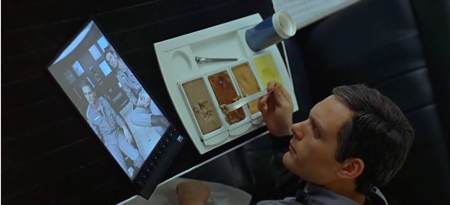
For a claim with only one structural feature, a rectangular screen with an aspect ratio near 1.5:1, what would a picture need to show?  It would seem that merely showing a display with such an aspect ratio would be sufficient.

Screen shot 2011 04 25 at 7 56 38 AM

HAL: Just what do you think you're doing, Dave?

Dave: Eating condiments for breakfast and watching this awesome roughly-1.5-to-1 aspect ratio image display, HAL.

(image from 2001: A Space Odyssey, 1968)


Previous Coverage:

Monday, April 18, 2011

Bloomberg: ITC Staff Recommends Siding With Nokia, HTC in Apple Patent Case

According to Bloomberg:

HTC Corp. (2498) and Nokia Oyj (NOK1V) shouldn’t be found liable of infringing Apple Inc. (AAPL)’s patents, the staff of the U.S. International Trade Commission recommended.

A staff lawyer, Erin Joffre, disclosed the position at the start of an ITC trial in Washington today in which Apple is seeking to ban imports of mobile phones made by HTC that run Google Inc.’s Android operating system, as well as block some Nokia devices. The staff acts on behalf of the public as a third party in the case. Its recommendations aren’t binding.

[...]

Update: I contacted Susan Decker of Bloomberg who told me that this did seem to be a separate recommendation based on a belief of lack of infringement, not just a reiteration of last weeks OUII request regarding the domestic industry requirement.

Monday, April 11, 2011

Kodak v. Apple @ ITC: Extended by a Month

In an action approved on April 8, 2011, the Commissioners in Kodak's USITC investigation against Apple and RIM (337-TA-703) voted 6-0 to extend the target date of the investigation by one month.  The new target date is June 23, 2011.

The Commission is currently considering final disposition of the January 24, 2011 Initial Determination by the ALJ, which found no violation of Section 337 by Apple.

Also listed as having been filed on April 8 were Apple's Brief on the Issues Under Commission Review and Kodak's Response to the Commission's Notice of Review, neither of which are available for public review.


Previous coverage:


Wednesday, April 6, 2011

Ogma v. Apple: Disturbing "Aspects" of the Patent System

A video display with a ~1.5-to-1 aspect ratio was non-obvious in 1995???

As mentioned in the prior post on these cases, one of the two asserted patents is US 5,825,427, titled Image display system.

Generally, when I see news coverage of a patent suit, I also find some misplaced outrage in the article or its comments based on just the title or abstract of the asserted patent.  When possible, I do my part to defend the patent system, pointing out that the actual claims being asserted are far narrower than the title, abstract, or news article imply, and that the patent system is, to a large extent, doing its job.

The '427 patent in this case, however, strains my ability to mount a defense.  Claim 3 of the '427, rather stunningly, reads as follows:

3. An image display system for displaying a video image comprising:

a video screen having a substantially rectangular configuration forming an aspect ratio of the horizontal dimension of said video screen to the vertical dimension of said video screen, said aspect ratio being between 1.45:1 and 1.60:1.

That's it.  An image display system with an aspect ratio between 1.45:1 and 1.60:1.

Apple is accused of infringing the '427 since the 960x640 display of the iPhone 4 and latest iPod Touch, and the 480x320 displays of the earlier iPhones and iPod Touches, have 1.5:1 aspect ratios, which fall within the claimed range.

Motion picture and video content have long been produced in a wide variety of aspect ratios, including some in the claimed range.  Computer graphics displays have also varied significantly in aspect ratio.  In terms of pixel aspect ratio, the claimed range would cover, for instance, at one extreme, the 640x400 or 320x200 video modes of some 1980s video controller cards.

Since my interpretation of the claim seemed implausibly broad given the prior art, I searched the exhibits of Ogma's ITC filing for clarity.  Exhibit 13 is titled "Claim chart applying U.S. Patent No. 5,825,427 to accused Apple product."  In essence, the claim chart says that Apple infringes the patent with the iPhone 4 because, yes, its display has a 1.5:1 aspect ratio.

So, as far as I can tell, a company formed this past January would like to stop the importation of millions of iPhones because the phones have displays with a 1.5:1 aspect ratio, and because that company has acquired a patent that the USPTO somehow issued that covers such displays based just on their aspect ratio.

Sometimes, things happen in the patent system that I can't defend.


(Note: Claim 1 is slightly narrower, requiring presentation of 4:3 and 16:9 content on such a screen.  However, letterboxing, to present wider aspect ratio content on a narrower aspect ratio screen, and pillarboxing, to present narrower aspect ratio content on a wider aspect screen, have been known in the art for decades.  Letterboxing became common even in the home with widescreen LaserDiscs of the 1980s, and more so with the advent of DVDs.  A common instance of pillarboxing would be the presentation of an Academy ratio film on a wider cinema screen or widescreen television.)

Ogma v. Apple @ ITC

In addition to its March EDTX complaints, on April 1, 2011, Ogma, LLC submitted a request to the US ITC for an investigation under section 337 of the Tariff Act of 1930.  The Complaint lists over thirty respondents in addition to Apple, including Activision Blizzard, Inc., Canon Inc., Seiko Epson Corporation, various Sony entities, and Lego.  It is titled "Certain Motion-Sensitive Sound Effects Devices and Image Display Devices and Components and Products Containing Same."

The Complaint involves the two patents from the EDTX cases:

  • 6,150,947, Programmable motion-sensitive sound effects device and
  • 5,825,427, Image display system. (I will be discussing at the '427 shortly in a separate post.)

Though the patents have been combined in a single complaint, many of the respondents appear to be accused of infringing only one or the other.

With regard to Apple:

On information and belief, either by itself, through its subsidiaries, or through third parties acting on its behalf, Apple is engaged in one or more of the manufacture, importation, sale for importation, or sale after importation into the United States of infringing electronic devices. On information and belief, the Accused Products include at least the following Apple products: iPad, iPhone, iPod Touch, 15-inch MacBook Pro. [...]

Ogma History

The Certificate of Formation for Ogma LLC (file number 801368943), a Domestic Limited Liability Company (LLC), was filed on January 12, 2011.  Per the Complaint, "Ogma focuses its business on acquiring, licensing and enforcing patented technology in the consumer electronics and communications industry, including the Asserted Patents."

Patent Assignments

The '427 patent was assigned from the inventor, Kenneth MacLeod, to Medici Portfolio Acquisition, LLC on 11/04/2010.  Medici, per its website, is comprised of three former McDermott Will & Emery attorneys.  The '427 was then assigned from Medici to Ogma LLC, 3301 W. Marshall Ave. Suite 303, Longview, TX (which is the contact address on Medici's site) on 1/25/2011, a few weeks after Ogma LLC was formed.

According to the Complaint, "Ogma acquired all rights in the '947 Patent from Shima LLC, a company created by James Shima, the inventor who researched and developed the motion-based technology that is now protected by the '947 Patent."

Attorney for Ogma

The Complaint was filed by James Otteson of Agility IP Law.  According to his bio, "Before founding Agility IP Law in January 2010, Jim was the Head of ITC Litigation at the Silicon Valley law firm of Wilson Sonsini Goodrich & Rosati, where he practiced starting in August 1992."


More to follow.

Monday, April 4, 2011

FOSS Patents: Updated Apple vs. Nokia battlemap

FOSS Patents: Updated Apple vs. Nokia battlemap:

"The entire 41-page document, which shows the escalation of the dispute and contains detailed reference list, is available on Scribd."

The final map on page one of the Scribd document is a bit confusing, but if you page through, Mueller has an annotated build-up of the chart, tracking each move and counter-move by the parties.

(Via Florian Mueller @ FOSS Patents.)

Wednesday, March 30, 2011

Nokia v. Apple: Take Me to the (Palm)Pilot

Three of the seven patents at issue in the newly filed D.Del. and ITC cases relate to database synchronization, particularly contact sync for personal information managers (PIMs).  The patents trace back to Puma Technology in the mid 1990s. Puma created Intellisync for the then US Robotics PalmPilot, prior to the 3Com acquisition and the later spin-out of Palm Inc.

Claim 2 of the asserted '911 patent seems quite broad.  It specifies that PIM records are selected based upon a filter comprising user-selectable conditions or fields that must match, and the subset of records is synchronized with a second database.

I would not be surprised to see reexamination requests for these patents in the near future.


Bibliographic information and a select claim from each of the three patents follows:


7,209,911 (continuation of '529, which is a continuation of '664)

Synchronization of databases using filters

Inventors: Boothby; David J. (Nashua, NH), Morgan; David W. (Derry, NH)
Assignee: Intellisync Corporation (San Jose, CA) 
Appl. No.: 09/776,452
Filed: February 2, 2001

2. A computer implemented method of synchronizing at least a first and a second personal information management database of the type having a plurality of records, wherein the records of the first and second personal information management databases include fields, the method comprising:

  • using a filter to select a plurality of records of the first database, 
    • the filter comprising one or more user selectable conditions or criteria that fields of records of the first database must match or fit to be selected, and
    • selecting the plurality of records of the first database includes evaluating fields of the first database with the user selectable conditions or criteria, and
  • synchronizing the selected records of the first database with records of the second database, 
    • the synchronizing comprising adding, modifying, or deleting records, whereby synchronization is performed for a subset of the records of the databases.

(claim 1 seems to differ in specifying "user-definable criteria" instead of "user selectable criteria.")


6,212,529 (continuation of '664)

Synchronization of databases using filters

Inventors: Boothby; David J. (Nashua, NH), Morgan; David W. (Derry, NH), Marien; John R. (Nashua, NH)
Assignee: Puma Technology, Inc. (San Jose, CA) 
Appl. No.: 09/036,400
Filed: March 5, 1998

1. A computer implemented method of synchronizing at least a first and a second personal information management database wherein the records of at least the first database include a text field, the method comprising:

  • using a filter to select a plurality of records of the first database, 
    • the filter comprising one or more user definable conditions or criteria that a record must match or fit to be selected, 
      • wherein the conditions or criteria include a user definable text criterion, and selecting the plurality records of the first database includes comparing the text field with the text criterion; and
  • synchronizing the selected records of the first database with records of the second database, 
    • the synchronizing comprising adding, modifying, or deleting records,
  • whereby synchronization is performed for a subset of the records of the databases.


6,141,664

Synchronization of databases with date range

Inventors: Boothby; David J. (Nashua, NH)
Assignee: Puma Technology, Inc. (San Jose, CA) 
Appl. No.: 08/748,645
Filed: November 13, 1996

1. A computer implemented method of synchronizing at least a first and a second database each containing dated records such as events, wherein the records of the first database extend across a narrow date range narrower than the date range of the records of the second database, the method comprising:

  • performing a prior synchronization across a prior date range set using the date of the prior synchronization and the narrow date range;
  • storing the prior date range and a history file containing information representative of the content of the databases following the prior synchronization;
  • performing a current synchronization across a date range that combines the prior date range with a current date range set using the date of the current synchronization and the narrow date range.


Tuesday, March 29, 2011

Nokia v. Apple: Why now?

Why is Nokia launching a flurry of patent suits and ITC investigations now, four years after the iPhone was announced?  More than wanting a cut of Apple's profits, I think it's about needing licenses to Apple's patents to stay in the game.


Over at FOSSPatents, Florian Mueller ponders Nokia's motivations:
Many observers and analysts will now try to form an opinion on whether this latest action by Nokia is a sign of strength or weakness. I have thought about this and concluded that there is a significant degree of frustration shining through Nokia's announcement because things take so long, but more than anything else, Nokia is sending out a strong and unambiguous message that at the end of this epic battle Apple is going to have to send royalty checks to Finland.
Nokia's patent portfolio is roughly five times larger than Apple's. They both operate in the same industry resulting from the convergence of computing and communications technologies. Theoretically one "killer patent" can be stronger than a thousand other patents, and there are indeed significant quality differences between the patent portfolios of major high tech companies. But it's hard to imagine that Nokia's patents are, on average, so much weaker than Apple's that the outcome could be anything else than Apple being required to pay.
I personally have no trouble imagining that Nokia's patents are so much weaker, especially when we follow the money, and particularly, the profits.

While the relative size of Nokia's patent portfolio is certainly relevant, the direction in which money will eventually flow is presumably related to the financial damage each party's portfolio could do to the other party, and each party's ability to take the risk of such damage.  Damages, in turn, should be related to profit contributions of the inventive aspects of the patents.

Apple's share of mobile phone industry profits exceeds the combined profits of the rest of the vendors combined.   Some may argue that Apple's handset profits are derived from the persuasive marketing of "shiny things."  I would argue that their profits are highly related to the inclusion in their products of the signature iPhone features, which Apple itself, as the first mover, has patented extensively.

Why is Nokia launching a flurry of patent litigation activity right now?  I suspect a key factor is the recent agreement with Microsoft.  If the new Microsoft-Nokia phones are profitable, a significant portion of the profits will likely be attributable to their having those signature iPhone-like features.  Apple could make a very strong argument, based on the profit share in the market, that it is those features that are key to Nokia's profits, if such profits arise.

Apple likely has more than a "killer patent."  They have a "killer portfolio," because they decided to "think different" about this space for years before anyone else knew what they were doing.  I suspect Nokia desperately wants a cross-license agreement so they can continue to play.

Nokia files second ITC complaint against Apple

Via Nokia:


Published March 29, 2011
Alleges Apple infringes additional Nokia patents in virtually all products
Espoo, Finland - Nokia has filed a further complaint with the United States International Trade Commission (ITC) alleging that Apple infringes additional Nokia patents in virtually all of its mobile phones, portable music players, tablets and computers.
The seven Nokia patents in the new complaint relate to Nokia's pioneering innovations that are now being used by Apple to create key features in its products in the areas of multi-tasking operating systems, data synchronization, positioning, call quality and the use of Bluetooth accessories.
This second ITC complaint follows the initial determination in Nokia's earlier ITC filing, announced by the ITC on Friday, March 25. Nokia does not agree with the ITC's initial determination that there was no violation of Section 337 in that complaint and is waiting to see the full details of the ruling before deciding on the next steps in that case.
In addition to the two ITC complaints, Nokia has filed cases on the same patents and others in Delaware, US and has further cases proceeding in Mannheim, Dusseldorf and the Federal Patent Court in Germany, the UK High Court in London and the District Court of the Hague in the Netherlands, some of which will come to trial in the next few months.
"Our latest ITC filing means we now have 46 Nokia patents in suit against Apple, many filed more than 10 years before Apple made its first iPhone," said Paul Melin, Vice President, Intellectual Property at Nokia. "Nokia is a leading innovator in technologies needed to build great mobile products and Apple must stop building its products using Nokia's proprietary innovation."
During the last two decades, Nokia has invested approximately EUR 43 billion in research and development and built one of the wireless industry's strongest and broadest IPR portfolios, with over 10,000 patent families. Nokia is a world leader in the development of handheld device and mobile communications technologies, which is also demonstrated by Nokia's strong patent position.

Details to follow when the filing becomes available.

Monday, March 28, 2011

Kodak Was Granted Full Commission Review by 5-1 Vote

The just-published voting record for the decision on March 25 to allow full commission review in Investigation 337-TA-703 reveals a 5-1 vote in favor.

For: Commissioners Pinkert, Aranoff, & Pearson, Vice Chairman Williamson, and Chairman Okun

Against: Commissioner Lane

The lop-sided vote is not surprising given the number of issues the parties were directed to brief for the full review.

Sunday, March 27, 2011

Kodak v. Apple at the ITC: What Happens Now?

On March 25, 2011, the U.S. International Trade Commission "determined to review the final initial determination (“ID”) issued by the presiding administrative law judge (“ALJ”) on January 24, 2011, finding no violation of section 337 in the above- captioned investigation."

The breadth of what the parties are now asked to brief suggests the possibility of a fresh review of the infringement case, taking into account prior ITC claim constructions and the successful reexam of the '218.

The parties are being asked to address:

  1. whether the ALJ permissibly relied on prior art combinations that Kodak did not have a chance to address and whether they render claim 15 invalid for obviousness,
  2. whether the ALJ should have considered the claim constructions in Inv. No. 337-TA-663 (prior Kodak ITC case against LGE) and what effect those constructions should have in this case,
  3. whether the ALJ should have considered the reexaminations and what effect those reexaminations should have in this case,
  4. whether U.S. Patent No. 5,493,335 (the Pularski '335 discussed in a prior post) is prior art, and if so, on what statutory basis,
  5. the meaning of “color pixel value” in part (b) of claim 15 and whether is is “the value of a color pixel”.


The weight given to the reexamination is certainly a key issue.  A presumption that the claims are valid based on the results of the reexam would move the discussion substantially toward item 5, and the associated issues of YCC color space, RGB values, and the meaning of a "at least three different colors."

For reference, claim 15, element (b):

(b) a motion processor for generating from the captured images, a second number of color pixel values provided in a second color pattern having at least three different colors and representative of a series of motion images to be previewed, the second number of color pixel values being less than the first number of color pixel values, and the second color pattern being different from the first color pattern;

The Commission also asks for written submissions on the form of remedy, should one be required.  The Commission has the power to "(1) issue an order that could result in the exclusion of the subject articles from entry into the United States, and/or (2) issue one or more cease and desist orders that could result in a respondent being required to cease and desist from engaging in unfair acts in the importation and sale of such articles."  The impact that a block of importation of Apple products would have on the public and the economy, however, make that path highly unlikely.

Sources:

  • US ITC Investigation 337-TA-703 NOTICE OF COMMISSION DETERMINATION TO REVIEW A FINAL DETERMINATION OF NO VIOLATION OF SECTION 337; SCHEDULE FOR FILING WRITTEN SUBMISSIONS ON THE ISSUES UNDER REVIEW AND ON REMEDY, THE PUBLIC INTEREST, AND BONDING
  • US Patent 6,292,218