Showing posts with label Lodsys. Show all posts

Wednesday, July 27, 2011

Lodsys: Response to Apple's Motion to Intervene

It is hard to find humor in the Lodsys situation. The livelihoods of good people are being threatened. Nonetheless, Lodsys is inadvertently providing a small bit of comic relief.

On June 10, 2011, Apple filed a motion to intervene in the Lodsys case against iOS developers. In essence, Apple said that Apple is licensed, and that developers were using Apple's hardware and servers that practiced the inventions, if the inventions were being practiced at all.

Today, Lodsys filed its Response in Opposition to Apple's motion. Mild comedy ensues.

As background, recall Mark Small's blog post from May 31:

On May 22nd, Apple’s chief lawyer Bruce Sewell unequivocally announced that Apple’s license to the Lodsys patents gave Apple’s 3rd party developers complete and “undisputable” freedom to use the covered inventions without paying royalties or fearing lawsuits. ...

The letter was very surprising as Apple and Lodsys were in confidential discussions and there was clearly disagreement on the interpretation of the license terms of Apple’s agreement. Before, during and after these interactions, Lodsys has carefully considered this issue and consulted several legal experts to consider Apple’s claims.  We stand firm and restate our previous position that it is the 3rd party Developers that are responsible for the infringement of Lodsys’ patents and they are responsible for securing the rights for their applications.  (emphasis added)

Well, it certainly sounded like Lodsys read Apple's license to the patents and disagreed with Apple about what the license said.

From today's filing, though:

Moreover, Apple has repeatedly refused to provide information relevant to its request for intervention. For example, Apple previously refused to provide even Lodsys's counsel with a complete copy of the License and, instead, redacted all but two paragraphs of the License. ... Subsequently, Apple filed the license under seal for attorneys' eyes only, so Lodsys could not review the actual terms of the license [REDACTED] Apple's disingenuous conduct and repeated attempts to hide the ball should not be rewarded.

Wait... Lodsys didn't have a copy of the license? Lodsys bought encumbered patent assets, sued a known licensee's partners, criticized the licensee's interpretation of the license, and they didn't even have a copy of the license? They are whining that Apple wouldn't show them a copy? I find that to be humorous.

(One theory as to how this could have happened: Apple obtained a bulk license to a long list of patents from Intellectual Ventures, including the Lodsys/Abelow patents. The license agreement contained confidentiality provisions for both parties. When IV "sold" these particular patent assets, they could not provide the full license agreements to the "buyer" due to the confidentiality agreement. Just a guess.)

Also amusing:

Third, Apple asserts that the defendants are allegedly individuals or "small entities with limited resources." ... But Apple prematurely filed its Motion before Lodsys filed its Amended Complaint [dkt. no. 26] against several large companies with substantial financial and technical resources... Accordingly, there can be no serious dispute that the defendants will more than adequately represent Apple's purported interest.

Let's review the timeline:

  1. Lodsys originally sued only small developers.
  2. Apple moved to intervene based in part on an argument that the developers lacked the means/knowledge to defend.
  3. Lodsys added some large developers to the suit.
  4. Lodsys says Apple filed "prematurely."

Right... Apple was premature. Another theory might come to the Court's mind though, like, perhaps, Lodsys added large developers to the suit specifically to counter Apple's point about developers' limited resources in an effort to improve the odds of keeping Apple out of the case.


There's more in the filing, but time is short. One thing is quite clear, though: Lodsys fears Apple's involvement in the case. Keep your fingers crossed that Apple's motion to intervene is granted.

Keep Calm and Carry On.


Previous Coverage:


Saturday, July 2, 2011

Lodsys: DriveTime Automotive Group Adds Another DJ

On June 30, 2011, DriveTime Automotive Group filed a declaratory judgment action against Lodsys in the District of Arizona. DriveTime calls out the Lodsys business model in the filing:

14. On information and belief, Lodsys has a well-known reputation as a “patent troll,” which refers to companies that acquire broad or ambiguous patents and then claim they cover specific and financially productive activities in attempt to generate revenue from litigation or the threat of litigation. These companies never actually manufacture anything covered by the patents they acquire – they generate revenue from litigation and the threat of litigation alone. This practice is becoming more and more common, much to the concern of the technological and legalcommunities. Lodsys is one of the latest to attempt to profit from this disturbing trend.

15. On information and belief, Lodsys has targeted numerous companies throughout the United States with demands that the companies either pay a license or settlement fee in exchange for a covenant not to sue, or in the alternative, face the exorbitant cost of defending a patent infringement lawsuit.

16. On information and belief, many of the companies targeted by Lodsys accede to its demands despite the lack of merit to the patent infringement claims, because by design, the cost of settlement, while not cheap, is much less significant than the average cost of a patent infringement defense. [via PriorSmart]

Every new declaratory judgment action can be considered a small bit of good news for iOS developers. No single DJ will cost Lodsys enough to materially impact its profitability, but they will add up.

It is very important to the development community that the Lodsys model, asserting patents against many parties who do not actually infringe to obtain nuisance licensing fees, does not appear profitable to imitators. The companies filing DJs are doing their part to send that message.


Previous Coverage:

Friday, July 1, 2011

Lodsys: Tech 411 Podcast Episode 5

A few days ago, Todd Moore wrote and asked me if I'd be a guest on the Tech 411 podcast. Todd had discussed Lodsys on a few earlier episodes, and then, curiously, received a Lodsys letter himself with regard to his TMSoft White Noise app.

I accepted the invitation and was a guest on Episode 5. The Lodsys discussion starts at around 18:20, but give the rest a listen. It's a good show. Give them a good rating on iTunes while you are at it.


Previous Coverage:


Wednesday, June 15, 2011

Lodsys: Hints from the '078 File History

A patent's file history can provide interesting admissions from the applicant about the limitations of the claims. The admissions in the '078 file history could be problematic for Lodsys' current assertions.

During prosecution of the Abelow '078 patent now asserted by Lodsys, an Office Action issued containing a 102(e) rejection based on Kaplan, US 5,237,157. Briefly, the Kaplan '157 disclosed a jukebox that elicited feedback from the user about particular CDs loaded within.


Screen shot 2011 06 15 at 9 11 01 PMScreen shot 2011 06 15 at 9 10 15 PM

Figures from the Kaplan '157. Feedback is solicited about the CDs, not the jukebox. Abelow's attorney said that kept Kaplan from anticipating the Abelow '078 claims.


Inventor Dan Abelow's attorney said the Kaplan '157 did not anticipate Abelow's claims, meaning Kaplan did not disclose every element of Abelow's claims. His attorney made the following distinction:

"In addition, if the Examiner for the sake of argument considers music kiosks in Kaplan to be "units of a commodity," one still would not have arrived at the claimed invention since a kiosk user-interface in Kaplan allows a user to rate music CDs but is not configured to elicit from a user information about the user's perception of the kiosk."

Abelow '078 File History, Arguments of Attorney Michael V. Messinger, 9/29/2005 (emphasis added)


So, we know from Mr. Messinger's arguments on behalf of Mr. Abelow that a distinguishing feature of the '078 is that information about the "unit of a commodity" itself is elicited, not information about what is loaded within. Thus, the '078 is limited to things like, perhaps, a fax machine that elicits information from the user about the fax machine itself. Conveniently, the Abelow '078 patent has a picture of precisely that.

Screen shot 2011 05 31 at 11 03 07 PM

Figure 2 of the Abelow '078 patent asserted by Lodsys

In view of this limitation, for a system of iPads to meet the limitations of claim 1 of the '078, each iPad would need to be configured to elicit information from the user about the iPad itself, not the about an app or about something else. In the case of a ForSee survey, the survey computer would need to be eliciting information about the survey computer itself, not about a different web site or about sneakers.

This narrowed interpretation of the claims by the prosecuting attorney is no surprise. The attorney was explaining what the claims actually say.  Unfortunately, Lodsys now seems to be saying something quite different.


Previous Coverage:


Lodsys: What to Do If You Receive a Lodsys Letter

This is a cross-post of a guest post I wrote for Groklaw on June 14, 2011. Also see the follow-up post from Mark Webbink, new editor of Groklaw, Executive Director of the Center for Patent Innovations, a research and development arm of New York Law School's Institute for Intellectual Law & Property, and former Red Hat General Counsel.


What to Do If You Receive a Lodsys Letter
~ by Patrick T. Igoe, Esq.

If you are a developer and you receive a letter from Lodsys alleging patent infringement, my primary advice, of course, must be, "see an attorney." However, the more you know, the better, faster, and more efficiently an attorney can help you.

Background

On May 13, 2011, developers of iOS apps began reporting receipt of letters from Lodsys, LLC.  In the letters, Lodsys CEO Mark Small asserted that the developers were making use of technology covered by patents now owned by Lodsys. We have since learned that The New York Times and customers of ForSee Results and OpinonLab were also receiving Lodsys letters in that timeframe.

According to Lodsys, Dan Abelow, the inventor listed on the asserted patents, began his patenting efforts in 1988.  He sold the resulting portfolio to Intellectual Ventures, which assigned them to a holding company, in 2004. Intellectual Ventures licensed them to certain of its customers, then sold off the remaining rights, which ended up with Lodsys, LLC, which is now asserting the patents.

In the case of at least some of the iOS developers, Lodsys set a twenty-one day deadline from the May 11 letter date for developers to respond. Lodsys indicated separately that its licensing terms were "0.575% of US revenue over for the period of the notice letter to the expiration of the patent, plus applicable past usage." Lodsys did not wait the full twenty-one days, instead filing suit in the Eastern District of Texas on May 31.

The stated goal of Lodsys is to "make relatively small amounts per licensee, but to have the large volume of licensees aggregate to be a worthwhile business." Given that business plan, Lodsys can be expected send letters to many more developers.

If you receive a letter from Lodsys, my primary advice, of course, must be, "see an attorney." However, the more you know, the better, faster, and more efficiently an attorney can help you.

Read the Patent, Not the Blogs.

It should go without saying, but do not believe everything you read on the Internet, especially about patent cases. It appears, especially with patent coverage, that the desire to post quickly or mold the story to fit an agenda often trump factual analysis.

For instance, early articles and posts about Lodsys repeatedly parroted Lodsys' own broad characterization of the patent claims, using phrases like "a patent on Apple's in-app purchase system." One commentator, based on just an abstract, went even further than Lodsys, saying a patent seemed to cover "any kind of communication over a network."

Even worse, nearly all Lodsys coverage overlooked two very fundamental questions:

  • Do the patent claims cover anything similar to Apple's in-app purchase system?
  • Do the patent claims cover developers' use of such a system?

Those questions can only be answered with consideration of the patent and its claims.

    Focus on the Patent Claims.

    Infringement of a patent is defined in 35 U.S.C 271. Generally speaking, to be liable for infringement, an accused direct infringer must make, use, sell, or import the patented invention, or perform all of the steps of the patented process. A party may also be liable for inducing infringement or providing a component specifically for use in infringement.

    Patents end with claims. Those claims define the bounds of the legal monopoly granted by the patent. The patent claims are used to determine whether or not there is infringement. That makes the patent claims extremely important. (Despite their importance, you will find massive blog posts on some sites giving advice about Lodsys that fail to even mention the patent claims or hint that they have been read.)

    Here is a claim that is being asserted against iOS developers by Lodsys, claim 1 of US7,222,078:

    1. A system comprising:

    • units of a commodity that can be used by respective users in different locations,
    • a user interface, which is part of each of the units of the commodity, configured to provide a medium for two-way local interaction between one of the users and the corresponding unit of the commodity, and further configured to elicit, from a user, information about the user's perception of the commodity,
    • a memory within each of the units of the commodity capable of storing results of the two-way local interaction, the results including elicited information about user perception of the commodity,
    • a communication element associated with each of the units of the commodity capable of carrying results of the two-way local interaction from each of the units of the commodity to a central location, and
    • a component capable of managing the interactions of the users in different locations and collecting the results of the interactions at the central location.

    Regardless of your level of familiarity with patents, "in-app purchase" is not the phrase that will come to mind. You also do not need to be a patent expert to find some more specific problems with Lodsys' infringement assertions.

    First, this is a system claim requiring multiple units of a hardware device, but the claim is being asserted against iOS application developers and companies using server-based solutions from other companies, like ForSee Results. In the case of the iOS developers, the "units of a commodity" under any reasonable claim mapping would seem to be the iPhone, iPod Touch, or iPad. The accused developers do not make or sell iOS hardware. Second, the "component capable of managing the interactions" sounds much more like Apple's iTunes Store servers than anything produced by an iOS developer.

    Thus, I argued it would be Apple, if anyone, not the iOS developer, who would be making, using, or selling most of such a system. Apple seemed to agree and sent Lodsys a letter saying as much. Apple has since filed a motion to intervene in the case, asserting that Apple itself is licensed to the Lodsys patent and that developers' use of Apple's systems and APIs would be covered under the license if the patented technology was used.

    Question the Claim Chart.

    The burden is on the patent-holder to show that you are infringing the patent. Many times, the demand letter or "offer of a license" will come with a claim chart. Claim charts are supposed to show how each element of a patent claim is or is not embodied in a product or process. Expect an NPE like Lodsys, however, to point out only the strengths of such a mapping, not the weaknesses.

    In every Lodsys claim chart I have seen, Lodsys has cherry-picked a few words from each claim element, put them in a yellow bubble, and pointed to a portion of a screen shot of the targeted company's application or a browser showing the third-party web pages. Patent infringement, however, involves all of the words in every element of the patent claim.

    When evaluating the claim chart, focus on the claim language that was left out. Ask why it was left out. The answer may very well be that the language was left out because you do not infringe the claims as they are written.

    Don't Listen to the Doomsayers. Consider an Active Defense.

      Not only did most commentators fail to ask the important questions about the patent claims, but some even asserted that the answers to those questions did not matter. The basic argument was: The patent system is broken. The developers have no reasonable choice but to pay. It costs too much to fight. A license is cheaper than talking to an attorney.

      The success of a Lodsys-like business model, collecting small amounts from a large number of companies based on questionable claims of infringement, requires a low transaction cost for each collection. Targets that roll over without a fight, even when they are not infringing, keep transaction costs low and enable the business model.

      However, if transaction costs rise through legitimate defenses or declaratory judgment actions, the business model is strained. Lodsys needs developers to think it is cheaper to settle than it is to fight. Developers should consider, however, whether filing a declaratory judgment action in their own district might have the possibility of creating a less costly and more satisfying resolution. With a declaratory judgment action, it is Lodsys that is faced with a dilemma. For a small or medium sized target, it may be more economically sensible for Lodsys to drop the demand for the small licensing fee even if they somehow feel they could win. It may be especially compelling if major weaknesses are identified in the infringement case, as I believe they could be here.

      While the first targeted iOS developers did not follow the declaratory judgment path, larger Lodsys targets now have. ForSee Results, OpinionLab, ESET, and The New York Times have all filed such actions, asserting non-infringement and invalidity of the Lodsys patents.  Lodsys now must deal with cases in at least three jurisdictions. Lodsys may try to consolidate the cases, but things have already gotten more expensive.

      Finally, Again, Talk to an Attorney.

      Developers should not take legal advice from the Internet, and especially not from a non-attorney blog or a software development podcast. Every legal situation is different, which is why it is important to see an attorney. Show the attorney the claim chart you received. Analyze the claim language that was left out of the claim chart. Assess whether you could even be capable of infringing the patent. Then, discuss with your attorney whether to fight or just settle based on cost concerns. Be informed when you make the decision.


      For much more detail on these points, see my Lodsys posts at applepatent.com.


      Patrick T. Igoe, Esq. is the founder of Igoe Intellectual Property, LLC in Philadelphia, PA. He is a registered Patent Attorney with over a decade of prior experience in the architecture, design, implementation, and management of large-scale embedded-systems software. Mr. Igoe holds a B.S. in Computer Science, an M.S. in Software Development, and an M.S. in Imaging Science from RIT, an M.B.A. from Duke, and a J.D. from Temple. He is an inventor on ten issued U.S. patents in the digital print, social networking, and digital home entertainment spaces.

        Monday, June 13, 2011

        Lodsys: NYT, OpinionLab follow ForSee, ESET with DJs

        On June 13, 2011, both the New York Times and OpinionLab, Inc. filed motions for declaratory judgment against Lodsys, LLC in the Northern District of Illinois. These cases come on the heels of ForSee's June 6 filing, also in the Northern District of Illinois, and ESET, LLC's filing on June 10 in the Southern District of California.

        From the OpinionLab complaint:


        This is an action for declaratory relief that: (a) the OpinionLab Online User Feedback Technology (as defined herein) does not infringe any valid claim of United States Patent Nos. 5,999,908 (“the ‘908 patent”), 7,133,834 (“the ‘834 patent”), 7,222,078 (“the ‘078 patent”) or 7,620,565 (“the ‘565 patent”) (collectively, the “Patents-in-Suit”); and (b) the claims of each of the Patents-In-Suit are invalid and unenforceable. This is also an action for injunctive relief against LodSys that it be permanently restrained and enjoined from making any further allegations that OpinionLab and its clients and customers are infringing any of the claims of the Patents-In-Suit. This is also an action for damages against LodSys because its intentional, unfounded, and repeated allegations of infringement have the tendency to cause, and have caused, confusion, mistake, and deception in the marketplace and have inflicted harm to the goodwill, reputation, and business interests of OpinionLab in the business community in this judicial district and beyond.


        Both OpinionLab and the New York Times seek declaratory judgment of non-infringement and invalidity of the Lodsys patents.

        Screen shot 2011 06 13 at 10 43 22 PM


        Previous Coverage:

        Friday, June 10, 2011

        Lodsys: Apple Moves to Intervene

        Apple reiterates that it is licensed and that developers uses of Apple's products and services are covered under Apple's license.

        As foreshadowed by Apple GC Bruce Sewell's letter to Lodsys, Apple has now filed a Motion to Intervene in the EDTX patent infringement case filed against seven developers.

        In the proposed Answer and Counterclaim, Apple asserts, among other things:

        • Apple is licensed to the patents in suit, and Lodsys purchased the patents subject to Apple's license.
        • "Apple’s ability to use the technology embodied by the patents in suit in products and services offered to its customers is the essence of the value of Apple’s License to the patents in suit."
        • "...under the patent law doctrines of exhaustion and first sale, Developers are entitled to use, free from claims of infringement of the patents in suit, those products and services to which Apple is licensed."
        • "By commencing this suit against the Developers based on their use of products and services offered to them by Apple and by threatening other App developers, Lodsys has diminished the value to Apple of its License."

        The affirmative defense section, as expected based on Sewell's earlier letter, is based upon doctrines of exhaustion and first sale:


        44. As set out above, Apple is licensed to the patents in suit under the License. The License expressly permits Apple to offer and otherwise make available to its Developers products and services that embody the inventions contained in the patents in suit. Plaintiff’s infringement claims against the Developers are based substantially or entirely on the Developers’ use of products and services that Apple is authorized to provide under the License and which Lodsys claims embody the patents in suit.

        45. Under the patent law doctrines of exhaustion and first sale, the Developers can use the products and services Apple provides to them free of claims of infringing the patents in suit. Therefore, Lodsys’s claims against the Developers are barred by at least the doctrines of patent exhaustion and first sale.

        The answers to Lodsys's infringement allegations are boilerplate "Apple lacks knowledge or information..." denials. This makes sense. Apple does not need to specifically argue non-infringement since it is not a party accused of infringement and the legal analysis should not even reach infringement. Apple is licensed and provides most of the elements of the claims. The efficient path is to simply say Apple is licensed and whatever use of Apple's APIs and servers that is undertaken by developers is covered by that license. If the case somehow reached an infringement analysis, however, there would certainly be a good line of defense at that stage, as well.

        Apple includes exhibits comprising motions for intervention, and orders granted on those motions, from prior cases involving Intel and Microsoft.

        I will be unsurprised to see entries of appearance from certain Apple-recommended firms for multiple defendants in the near future.


        Previous Coverage:

        Thursday, June 9, 2011

        Lodsys: Anatomy of a BS Claim Chart

        Here's a quick look at how NPEs scare developers, mislead the press and non-attorney bloggers, and provide fodder for anti-patent alarmists.

        On June 6, 2011, Forsee Results, Inc. filed a declaratory judgment action against Lodsys. I have been a proponent of using DJs against Lodsys since my earliest posts. The Lodsys business model depends on targets rolling over quickly or waiting to be pulled into EDTX. Forsee is admirably doing neither.

        I have thoughts on the relative strengths and difficulties of the non-infringement and invalidity portions of the DJ case. For now, though, my focus is on the Lodsys "claim chart" sent to Adidas and filed as an exhibit with the Forsee DJ complaint. I've seen others from Lodsys very much like this one, but their recipients justifiably asked me not to disclose that they had shared them. The one sent to Adidas, however, is now public record.  Let's dig in...

        The "claim chart" is prefaced by a slide reciting the full claim:

        Screen shot 2011 06 09 at 5 17 25 PM

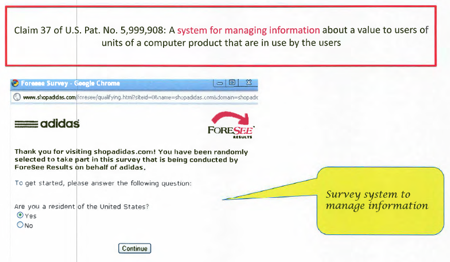
        Colorful. A walkthrough follows, element by element, of Lodsys's mapping of the claim to Forsee's survey as triggered from shopaddidas.com.  Starting with the preamble:

        Screen shot 2011 06 09 at 4 56 12 PM

        The first thing we notice is that Mark Small, CEO of Lodsys, uses really bad fonts and colors.  This alone may cost Lodsys its strong support from John Gruber.

        The second thing we notice is an apparent misunderstanding of patent law.  Under at least US patent law, both the words you color red AND the remaining black words from the patent claim are relevant to whether someone is infringing. Here, Lodsys identifies a "system to manage information," to show the concept of the red words. What about those pesky black words Lodsys left out? They say "...about a value to users of units of a computer product that are in use by the users."  The survey appears to be about the shopadidas.com web site, not about the value of "units of a computer product."

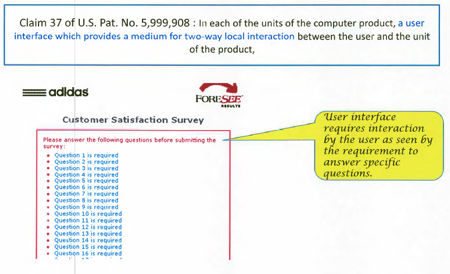
        Well, that's just the preamble. Lets see what the mapping of an actual claim element looks like:

        Screen shot 2011 06 09 at 5 31 37 PMA-ha! There is clearly something on shopadidas.com that seems to demonstrate all of the blue words from the claim about a UI and two-way interaction! The yellow callout bubble with the font from Kings Quest V tells us so.
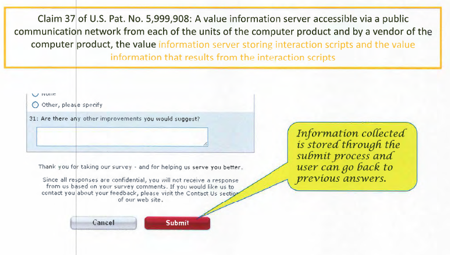
        Again, however, there are those pesky words in black. They say that the two-way interaction is "between the user and the unit of the product." What is Lodsys calling "the unit of the product?" The HTML page? The computer displaying the web page? This is a system claim. Isn't the "unit of the product" supposed to be a piece of hardware, like a fax machine? (See the fax machine in US5,999,908 Figure 2, for instance.)

        Perhaps the next element will lend some clarity:

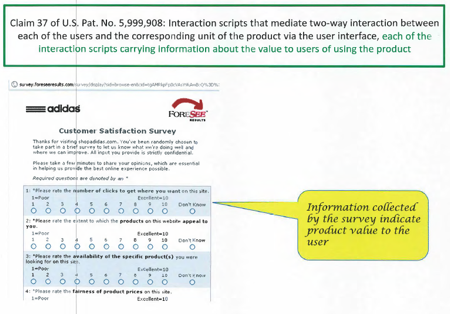
        Screen shot 2011 06 09 at 5 42 00 PM

        If you have followed along this far, you will not be surprised that for this claim element, Lodsys has again pulled a few words into the yellow bubble to assert there is a mapping. The missing words, though, again relate to "two way interaction between each of the users and the corresponding unit of the product via the user interface."

        The questions in this screen capture from the Forsee survey relate to the shopadidas.com site itself, to the products on the site, presumably sneakers, and to the prices of the products. Which of those is the "product" of the claim language about which information is being collected?

        The user is not having two-way interaction with a sneaker, so sneakers are out as "units of the product." The user is interacting with the survey website, but that appears to have a forseeresults.com address, not an adidas.com address. The questions are about shopadidas.com, but the user is no longer there, and shopadidas.com is not a unit of a product.

        Things get worse:

        Screen shot 2011 06 09 at 6 02 41 PM

        That yellow bubble we used to think we could trust is now ignoring the entire "server accessible via a public communication network" from the claim language.

        Last we checked, the survey was coming from a Forsee server. The letter with this claim chart went to Adidas. Who is the supposed infringer and what is the infringement theory? Forsee seems to own and operate the server. The physical units of the computer product would be from Dell, HP, Apple, etc.

        Much like in my analysis regarding the Apple iOS developers and their apps, Lodsys appears to be either intentionally ignoring important aspects of the claim that are not met by the targeted company's offering, or, instead, hiding some exotic joint infringement theory regarding a computer maker, the survey company, and the company using the survey software.

        If Lodsys has a legitimate infringement theory against Adidas, or the iOS developers, it is hiding it well. No such theory is articulated in this or the other claim charts I have seen.

        If you see Mark Small at Starbucks, do me a favor and please ask him: who is the infringer, what is the infringement theory, what are the "units of the computer product," and why are you using that font?


        Previous Coverage:


        Tuesday, May 31, 2011

        Lodsys: Developers Do Not Infringe the '078 Patent.

        Lost in the anti-patent/anti-NPE discussion of Lodsys is a fundamental fact: Developers do not infringe the Abelow '078 patent.

        Screen shot 2011 05 31 at 11 03 07 PM

        In his odd blog at Lodsys.com, CEO Mark Small expresses his views about Lodsys being an unfairly persecuted non-practicing entity just trying to assert its rights. Among his posts today is this one lamenting the coverage of Lodsys's actions:

        The stories have focused on narrow complaints

        Patents and the licensing of them:  a complicated system and how it’s wrong or broken (although many aspects do work well and a few aspects have challenges… like any complicated system).

        The small developer being unfairly picked on (without mentioning the many developers that do understand and play by the rules).

        Rolling developers into belonging to the enabling platform (Apple’s developers or Android developers) and how they are under attack from a troll (rather than it being a rights holder attempts to get paid for its property and questioning the full scope and veracity of the platform provider’s promises, or that App Developers have choices of what functionality to put in their applications and which platforms to sell on)

        My primary complaint about this case, however, is simply this:

        iOS developers do not directly infringe the '078 patent and their only potential joint infringer, Apple, is undisputedly licensed.

        Asserted claim 1 and dependent claim 24 of the '078 require multiple units of a commodity that each comprise a UI, a memory, and a communication element. These are physical elements of a system claim. The iOS developers do not provide a physical system, let alone one with multiple units of a commodity each with a UI, a memory, or communication element.  Apple, if anyone, provides those elements. Apple has not been named as a defendant.  Apple is licensed. (We haven't even reached other issues with the claims.)

        Lodsys asserts in the complaint that each developer-defendant "has infringed and continues to infringe, directly, indirectly, literally, under the doctrine of equivalents, contributorily, and/or through the inducement of others, one or more of the claims of the '078 patent."  In the claim charts I have seen, however, Lodsys implies only direct infringement by the iOS application itself, with strategic omission of claim language referencing hardware or the role of Apple servers.  Does Lodsys actually have a joint infringement theory under which developers infringe in conjunction with Apple as an already-licensed non-co-defendant? If so, they certainly have not articulated that theory, and the theory would certainly be novel.

        @jharrier pointed me to a nice article from Wilson Sonsini on divided/joint infringement defenses in EDTX, which summarizes the law as of early 2010 as follows:

        The Paymentech court ruled that direct infringement of a patent claim only occurs when a single actor either commits the entire act of direct infringement, or directs or controls the actions of all parties needed to commit the entire act of infringement. If multiple unrelated actors are required to perform all the actions of a method claim, then there can be no direct infringement. Furthermore, if there is no direct infringement, there can be no contributory infringement or inducement either. In other words, if no single actor is a direct infringer, then there can be no infringement of any kind.

        If any "mastermind" existed in the context of the '078, directing or controlling the actions of all parties, it would be Apple, not the developer. Apple, again, is licensed, by Lodsys's own admission.

        With only "notice pleading" required for the initial complaint, Lodsys is not yet required to explain its theory of how developers could possibly be infringing. It will be fascinating to see if they ever produce such a theory, or instead, whether the economics of patent litigation let them collect their checks before they are required to do so. Sadly, I suspect the latter is the business model.


        Note: I plan to take a look at the Abelow '565 in a future post.


        Previous Coverage:

        Lodsys: The $1,000 Offer.

        Lodsys's inadequate and caveated "offer" hints at a severe lack of confidence in the case.

        NewImage

        (via Wikipedia)

        In addition to blog posts about the filing of the complaint, Lodsys also posted a curious "offer" with regard to its demand letters today:

        While it is true that Apple and Lodsys have an obvious dispute about the scope of Apple’s license to the Lodsys Patents, we are willing to put our money where our mouth is and pay you something if we are wrong.  Therefore, Lodsys offers to pay $1,000 to each entity to whom we have sent an infringement notice for infringement on the iOS platform, or that we send a notice to in the future, if it turns out that the scope of Apple’s existing license rights apply to fully license you with respect to our claim relating to your App on Apple iOS.

        First, $1,000?  Seriously? Estimates of the number of targeted developers have been in the low teens.  Is $13,000 all Mr. Small is willing to risk? Furthermore that's only around two hours of a senior litigator's rate and would in no way cover a developer's expense for even basic evaluation of this case.

        Second, note the caveat in the offer. Mr. Small is not saying you get $1,000 if the Abelow patents are found invalid or, more importantly and likely, if you are found not to infringe since you do not meet all the claim elements. The narrow wording requires that "it turns out that the scope of Apple’s existing license rights apply to fully license you with respect to our claim relating to your App on Apple iOS."

        However, even Bruce Sewell did not claim developers are fully licensed within the scope of Apple's license.  He said:

        Because Lodsys’s threats are based on the purchase or use of Apple products and services licensed under the Agreement, and because those Apple products and services, under the reading articulated in your letters, entirely or substantially embody each of Lodsys’s patents, Lodsys’s threatened claims are barred by the doctrines of patent exhaustion and first sale.

        Sewell recognizes that it is Apple, not the developer, that provides most of the claim elements in any reasonable mapping of the claim, and asserts that Apple is licensed to practice the inventions.  He says developers are protected by Apple's license, not that developers are fully licensed.

        This is an empty offer from Lodsys. Make it $100,000 per developer and make the offer payable on a finding of invalidity or non-infringement, as well.  That would be putting your money where your mouth is.


        Previous Coverage:

        Lodsys: Complaint Filed in Eastern District of Texas

        On May 31, 2011, Lodsys filed a complaint for patent infringement against Combay, Inc., Iconfactory, Inc., Illusion Labs AB, Michael G. Karr d/b/a Shovelmate, Quickoffice, Inc., Richard Shinderman, and Wulven Game Studios.

        The complaint can be found here.

        More to follow.


        Previous Coverage:


        Monday, May 23, 2011

        Lodsys: Apple is Licensed. App Makers Protected by that License.

        The text of the letter from Apple's Bruce Sewell to Lodsys CEO Mark Small has just been posted at Macworld:

        ... Apple is undisputedly licensed to these patent and the Apple App Makers are protected by that license. There is no basis for Lodsys’ infringement allegations against Apple’s App Makers. Apple intends to share this letter and the information set out herein with its App Makers and is fully prepared to defend Apple’s license rights. ...

        As I asserted in multiple posts, Apple's devices and infrastructure would need to be included in the infringement analysis for all of the claim limitations to be met, and developers on their own do not directly infringe. Sewell argues the same:

        ...  Under your reading of the claim as set out in your letters, the allegedly infringing acts require the use of Apple APIs to provide two-way communication, the transmission of an Apple ID and other services to permit access for the user to the App store, and the use of Apple’s hardware, iOS, and servers.

        Claim 1 also claims a memory ... Once again, Apple provides, under the infringement theories set out in your letters, the physical memory in which user feedback is stored and, just as importantly, the APIs that allow transmission of that user feedback to and from the App Store, over an Apple server, using Apple hardware and software. ...

        Finally, claim 1 claims a component that manages the results from different users and collects those results at the central location. As above, in the notice letters we have seen, Lodsys uses screenshots that expressly identify the App Store as the entity that purportedly collects and manages the results of these user interactions at a central location.

        Thus, the technology that is targeted in your notice letters is technology that Apple is expressly licensed under the Lodsys patents to offer to Apple’s App Makers.  ...

        Always read the patent claims.

        I am very pleased to see Apple get involved. The drumbeat of advice to developers to give in or risk going bankrupt was getting quite loud. I hope no one listened to it. Financial pragmatism is one thing, but caving in without even a colorable theory of actual infringement is a step too far.


        Previous Coverage:


        Lodsys: Why Marco Arment is Wrong.

        Marco Arment's advice to simply roll over and pay Lodsys could be damaging not only to the developers taking his advice, but to the independent development community as a whole.

        Marco Arment is the founder of Instapaper and was a co-founder of Tumblr.  He currently has a podcast on Dan Benjamin's 5by5 network called Build and Analyze. I am a paid user of Instapaper apps and a fairly regular listener of Build and Analyze and Benjamin's other shows.  I think Arment and Benjamin are smart guys. When Arment or Benjamin's other co-hosts talk about what they know, the shows can be educational and inspiring. Occasionally, though, the co-hosts speculate about things they don't know, and the shows can be disappointing and infuriating.

        NewImage

        In episode 25 of Build and Analyze, Benjamin and Arment spent a good deal of time discussing the Lodsys situation. Within the first minute of discussion, Arment misstated the number of patents held by Lodsys, the term of a patent, and the title chain of the patents. Those were fairly benign errors. Far more dangerous, though, was Arment simply taking at face value Lodsys's broad characterization of the scope of the '078 patent, exaggerating it even further as support for his anti-patent arguments, and then implying a proper course of action for developers based on that misinformation:

        Arment: "This company has a couple of what sound like very broad patents... and one of them in particular... I'm not a lawyer of course, so please take all of this with a grain of salt... It just sounds like it could apply to any kind of communication over a network." (~19:30)

        No. The patent does not apply to, or sound like it could apply to, anything close to "any kind of communication over a network."

        Patents end with patent claims. Those claims define the bounds of the legal monopoly granted by the patent. Arment either did not even look at the claims before broadcasting his views to thousands of developers, or did not understand them. I suspect the former.

        As discussed at length in my previous posts, the Abelow '078 being asserted by Lodsys has significant limitations related to which party actually practices the invention, the scope of the system that is claimed, and the type of information that is collected on user perception. Each of those limitations are relevant to whether iOS developers infringe. The patent does not cover "any kind of communication over a network."


        Arment later discusses how he would respond to a Lodsys letter:

        Arment: "It's a horrible thing in principle, but if they ever hit me, I'd just pay it.  because the reality is... Yes, it sucks to lose that money, but it's not that much money and the alternatives are so much worse.  This is the kind of thing... you know, you can try to argue, oh you should make a big political stand...  The fact is you're going to lose, and you're going to lose a lot of money doing it." (~28:15)

        Arment is correct that standing up will cost money. I take serious issue with his assertion to developers, however, that "you're going to lose," especially when it appears he has not even read the patent claims.

        With the claim limitations described above, I have been unable to come up with a plausible explanation as to how the targeted developers could be, especially without Apple as a joint infringer, directly infringing the patent. Patent litigation is unpredictable, and yes, developers could lose nonetheless, but based on my read, this is far from a slam dunk for Lodsys.

        I also question whether, if everyone rolls over as Arment suggests, that it won't be "that much money." Arment seems to be making implicit assumptions that a Lodsys success will not inspire more NPEs, that other NPEs will request similarly low percentages of revenue, and that the total percentage of revenue sought across NPEs will still be low. I question all of these assumptions.

        There are plenty of issued patents out there. I assure you that NPEs are looking right now to buy more that might be stretched to arguably read on the Apple ecosystem. With such patents in hand, an NPE looking to replicate Lodsys's strategy could sensibly target the same developers who rolled over for Lodsys (or successful developers who publicly stated in podcasts that they would roll over). Those "small percentages" will add up.


        A Lodsys-like business model seems to depend heavily on developers holding beliefs like Arment's. Making money by collecting small amounts from large numbers of developers requires a low transaction cost for each collection. Developers who roll over based on these beliefs keep transaction costs low.

        If the transaction cost rises, however, perhaps through legitimate defenses or declaratory judgment actions, the NPE's costs skyrocket.  I think it is no coincidence that Lodsys is starting with a small group of developers. Achieving critical mass to jointly fund a declaratory judgment action for non-infringement or invalidity would be hard under any circumstances, but especially if there are never enough threatened developers at any one time to reach that critical mass.  If no one stands up and says "we're not infringing" in this round, though, what do you think Lodsys will do once it collects its first round of checks? Those who settle in early rounds will likely be funding the actions against other developers.


        Developers should not take legal advice from the Internet, and especially not from a software development podcast. Whether it is expensive or not, see an attorney. Show the attorney the claim chart you received from Lodsys. Spend some time, perhaps, on the claim language that Lodsys left out of the claim chart and why they left it out. Assess whether you could even be capable of infringing the patent given your role in the Apple ecosystem. Then, discuss with your attorney whether to roll over based on cost concerns. At least be informed when you do so.


        Update 5/23 1:50P: Marco responds here.  He mischaracterizes what I said (re-read the final paragraph above; he doesn't seem to have read the end of the patent or the end of my post), but clarifies his own opinion a bit.


        (Quick note: Dr. Drang took issue with the same Arment podcast and beat me to the punch.  I think our posts are complementary, though. Go take a look.)


        Previous Coverage: