Showing posts with label Ogma. Show all posts

Thursday, May 26, 2011

Ogma v. Apple: Settled

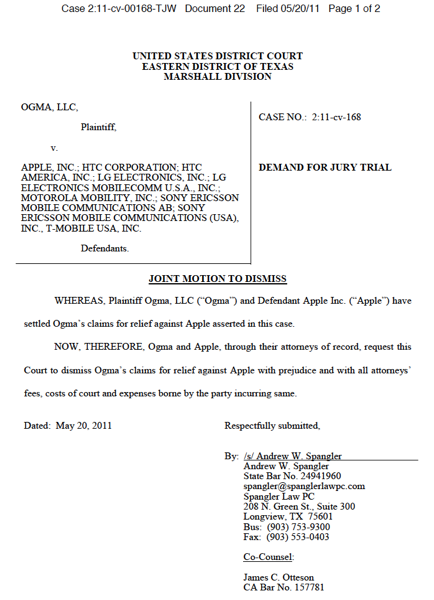
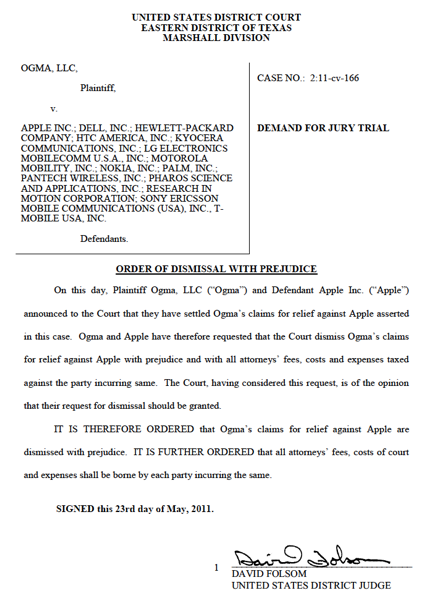
As anticipated after Apple no longer appeared as a respondent in the corresponding USITC matter, Apple has settled both cases filed against it by Ogma, LLC in the Eastern District of Texas.  One of the cases, 2:11-cv-168, involved the somewhat disturbing patent claims covering image displays based upon nothing more than their aspect ratios.

No information on settlement terms appears to have been announced.


Screen shot 2011 05 26 at 6 55 25 PM


Screen shot 2011 05 26 at 7 03 10 PM


Previous Coverage:

Monday, May 16, 2011

Ogma v. Activision, et al.: ITC Initiates Investigation, Apple Already Out.

The USITC announced on Friday, May 13, 2011 that it will institute an investigation based upon Ogma, LLC's complaint of infringement of its '947 sound effects and '427 screen aspect ratio patents against over thirty entities.

It appears that Apple was dropped as a respondent in the unpublished April 26, 2011 amended complaint, as it does not appear in the announcement of the investigation.  Seiko Epson, Epson, HTC, Motorola Mobility, Sanyo and Sharp also have disappeared.

Even with Apple no longer involved, I may still check in on this investigation periodically to see how the '427 fares against the prior art.  I suspect it will not do well.  The ITC case should also provide useful guidance for Apple in the still pending cases (2-11-cv-00166 and 2-11-cv-00168) in Marshall, TX, if Apple remains as a defendant.  Joint Motions to Dismiss the '947 cases against Motorola Mobility and RIM have already been filed and granted.


Previous Coverage:

Monday, April 25, 2011

Ogma v. Apple: A Prior Art Odyssey

In an earlier post, I discussed the surprising breadth of one of the claims asserted by Ogma, LLC against Apple.  Claim 3 of the asserted '427 patent reads as follows:

3. An image display system for displaying a video image comprising:

a video screen having a substantially rectangular configuration forming an aspect ratio of the horizontal dimension of said video screen to the vertical dimension of said video screen, said aspect ratio being between 1.45:1 and 1.60:1.

It is simply a claim on an image display system with an aspect ratio between 1.45:1 and 1.60:1.

Invalidating a patent claim requires the identification of appropriate prior art.  The prior art must pre-date the filing of the patent application, possibly by as much as a year, and must be "enabling."

One of my favorite ways to explain enabling prior art is via Star Trek.  If brilliant physicists invented Star Trek's "transporter" technology, the illustration of transporter technology on the Star Trek television series would not be enabling prior art.  While the idea is demonstrated in the television program, there is no description of the technology that would enable a skilled practitioner to build a transporter.

What constitutes "enabling" prior art, however, when a claim is as broad as claim 3 of Ogma's '427?  For a very broad claim, could a mere picture be enabling for prior art purposes?  The Manual of Patent Examining Procedure (MPEP) says "yes." Section 2101.04 states:

2121.04 Apparatus and Articles - What Constitutes Enabling Prior Art

PICTURES MAY CONSTITUTE AN "ENABLING DISCLOSURE"

Pictures and drawings may be sufficiently enabling to put the public in the possession of the article pictured. Therefore, such an enabling picture may be used to reject claims to the article. However, the picture must show all the claimed structural features and how they are put together. Jockmus v. Leviton, 28 F.2d 812 (2d Cir. 1928).

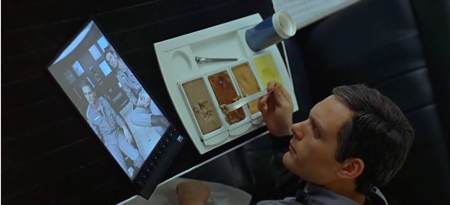
For a claim with only one structural feature, a rectangular screen with an aspect ratio near 1.5:1, what would a picture need to show?  It would seem that merely showing a display with such an aspect ratio would be sufficient.

Screen shot 2011 04 25 at 7 56 38 AM

HAL: Just what do you think you're doing, Dave?

Dave: Eating condiments for breakfast and watching this awesome roughly-1.5-to-1 aspect ratio image display, HAL.

(image from 2001: A Space Odyssey, 1968)


Previous Coverage:

Wednesday, April 6, 2011

Ogma v. Apple: Disturbing "Aspects" of the Patent System

A video display with a ~1.5-to-1 aspect ratio was non-obvious in 1995???

As mentioned in the prior post on these cases, one of the two asserted patents is US 5,825,427, titled Image display system.

Generally, when I see news coverage of a patent suit, I also find some misplaced outrage in the article or its comments based on just the title or abstract of the asserted patent.  When possible, I do my part to defend the patent system, pointing out that the actual claims being asserted are far narrower than the title, abstract, or news article imply, and that the patent system is, to a large extent, doing its job.

The '427 patent in this case, however, strains my ability to mount a defense.  Claim 3 of the '427, rather stunningly, reads as follows:

3. An image display system for displaying a video image comprising:

a video screen having a substantially rectangular configuration forming an aspect ratio of the horizontal dimension of said video screen to the vertical dimension of said video screen, said aspect ratio being between 1.45:1 and 1.60:1.

That's it.  An image display system with an aspect ratio between 1.45:1 and 1.60:1.

Apple is accused of infringing the '427 since the 960x640 display of the iPhone 4 and latest iPod Touch, and the 480x320 displays of the earlier iPhones and iPod Touches, have 1.5:1 aspect ratios, which fall within the claimed range.

Motion picture and video content have long been produced in a wide variety of aspect ratios, including some in the claimed range.  Computer graphics displays have also varied significantly in aspect ratio.  In terms of pixel aspect ratio, the claimed range would cover, for instance, at one extreme, the 640x400 or 320x200 video modes of some 1980s video controller cards.

Since my interpretation of the claim seemed implausibly broad given the prior art, I searched the exhibits of Ogma's ITC filing for clarity.  Exhibit 13 is titled "Claim chart applying U.S. Patent No. 5,825,427 to accused Apple product."  In essence, the claim chart says that Apple infringes the patent with the iPhone 4 because, yes, its display has a 1.5:1 aspect ratio.

So, as far as I can tell, a company formed this past January would like to stop the importation of millions of iPhones because the phones have displays with a 1.5:1 aspect ratio, and because that company has acquired a patent that the USPTO somehow issued that covers such displays based just on their aspect ratio.

Sometimes, things happen in the patent system that I can't defend.


(Note: Claim 1 is slightly narrower, requiring presentation of 4:3 and 16:9 content on such a screen.  However, letterboxing, to present wider aspect ratio content on a narrower aspect ratio screen, and pillarboxing, to present narrower aspect ratio content on a wider aspect screen, have been known in the art for decades.  Letterboxing became common even in the home with widescreen LaserDiscs of the 1980s, and more so with the advent of DVDs.  A common instance of pillarboxing would be the presentation of an Academy ratio film on a wider cinema screen or widescreen television.)

Ogma v. Apple @ ITC

In addition to its March EDTX complaints, on April 1, 2011, Ogma, LLC submitted a request to the US ITC for an investigation under section 337 of the Tariff Act of 1930.  The Complaint lists over thirty respondents in addition to Apple, including Activision Blizzard, Inc., Canon Inc., Seiko Epson Corporation, various Sony entities, and Lego.  It is titled "Certain Motion-Sensitive Sound Effects Devices and Image Display Devices and Components and Products Containing Same."

The Complaint involves the two patents from the EDTX cases:

  • 6,150,947, Programmable motion-sensitive sound effects device and
  • 5,825,427, Image display system. (I will be discussing at the '427 shortly in a separate post.)

Though the patents have been combined in a single complaint, many of the respondents appear to be accused of infringing only one or the other.

With regard to Apple:

On information and belief, either by itself, through its subsidiaries, or through third parties acting on its behalf, Apple is engaged in one or more of the manufacture, importation, sale for importation, or sale after importation into the United States of infringing electronic devices. On information and belief, the Accused Products include at least the following Apple products: iPad, iPhone, iPod Touch, 15-inch MacBook Pro. [...]

Ogma History

The Certificate of Formation for Ogma LLC (file number 801368943), a Domestic Limited Liability Company (LLC), was filed on January 12, 2011.  Per the Complaint, "Ogma focuses its business on acquiring, licensing and enforcing patented technology in the consumer electronics and communications industry, including the Asserted Patents."

Patent Assignments

The '427 patent was assigned from the inventor, Kenneth MacLeod, to Medici Portfolio Acquisition, LLC on 11/04/2010.  Medici, per its website, is comprised of three former McDermott Will & Emery attorneys.  The '427 was then assigned from Medici to Ogma LLC, 3301 W. Marshall Ave. Suite 303, Longview, TX (which is the contact address on Medici's site) on 1/25/2011, a few weeks after Ogma LLC was formed.

According to the Complaint, "Ogma acquired all rights in the '947 Patent from Shima LLC, a company created by James Shima, the inventor who researched and developed the motion-based technology that is now protected by the '947 Patent."

Attorney for Ogma

The Complaint was filed by James Otteson of Agility IP Law.  According to his bio, "Before founding Agility IP Law in January 2010, Jim was the Head of ITC Litigation at the Silicon Valley law firm of Wilson Sonsini Goodrich & Rosati, where he practiced starting in August 1992."


More to follow.