Showing posts with label EDTX. Show all posts

Wednesday, July 27, 2011

Affinity Labs of Texas v. Apple & AAMP

On July 26, 2011, Affinity Labs of Texas filed suit for patent infringement against Apple and AAMP of Florida. The suit was filed in Beaumont, TX. Affinity Labs has sued Apple before [Ars/Chris Foresman] over different patents.

In this case, the patents in suit are:

  • US 7,634,228, Content Delivery System and Method
  • US 7,778,595, Method for Managing Media

With regard to Apple:

Upon information and belief, each of the Defendants has infringed and, if not enjoined, will continue to infringe one or more claims of the ‘228 Patent, without authority, one or more of the following acts: (a) making, using, offering for sale, or selling within the United States products that infringe one or more claims of the ‘228 Patent, in violation of 35 U.S.C. § 271(a); (b) importing into the United States products that infringe one or more claims of the ‘228 Patent, in violation of 35 U.S.C. § 271(a); (c) inducing infringement of one or more claims of the ‘228 Patent, in violation of 35 U.S.C. § 271(b); and/or (d) contributing to the infringement of one or more claims of the ‘228 Patent, in violation of 35 U.S.C. § 271(c) (the “acts of infringement of the ‘228 Patent”).

Similar allegations are made regarding the '595.

The '228 relates generally to conveying media metadata from something like an iPod for display on something like an iPod dock. Claim 1 of the '228 reads:

1. A media managing method comprising:

  • storing a media file in a memory system of a portable hand-held device that is not a conventional personal computer or a laptop computer, wherein the portable hand-held device further has a display and a processor;
  • storing a collection of information about the media file in the memory system, wherein the collection includes data representing a name for the media file;
  • communicating at least some of the collection from the portable hand-held device to a different electronic device in order to allow a user to view a soft button comprising the name on an associated display of the different electronic device;
  • and thereafter receiving a signal in the portable hand-held device to begin playing the media file by the portable hand-held device in response to a selection of the soft button at the different electronic device; and
  • outputting a played version of the media file across a physical interface of the portable hand-held device while the media file remains stored on the portable hand-held device, wherein the physical interface is configured to facilitate a communicative coupling of the portable hand-held device and the different electronic device, further wherein the physical interface is not circular and has a width dimension and a length dimension that is longer than the width dimension.

The '595 relates to altering output of a played audio file in connection with a receipt of an incoming telephone call, but with some limitations related to streaming broadcast apps:

1. An audio system comprising:

  • a portable device having a single physical interface configured to releasably engage a contacting portion of an interconnection system to form at least a portion of a communication path between the portable device and a separate electronic device, 
    • wherein the physical interface has a generally rectangular shape and is configured to couple a first conductive element of the interconnection system with a component of the portable device that outputs data and couple a second conductive element of the interconnection system with a recharging circuit of the portable device,
    • wherein the portable device is configured to accept an over the air download of an application that allows the portable device to request an audio stream representing a local broadcast signal for a channel located remote from a then current location of the portable device;
  • the portable device having a wireless communication module operable to receive an incoming telephone call and the audio stream; and
  • the portable device having an audio output engine configured to output information representing a played audio file to the separate electronic device via the physical interface and to alter an outputting of the played audio file in connection with a receipt of the incoming telephone call and configured to output the audio stream.

Tuesday, May 31, 2011

Lodsys: Developers Do Not Infringe the '078 Patent.

Lost in the anti-patent/anti-NPE discussion of Lodsys is a fundamental fact: Developers do not infringe the Abelow '078 patent.

Screen shot 2011 05 31 at 11 03 07 PM

In his odd blog at Lodsys.com, CEO Mark Small expresses his views about Lodsys being an unfairly persecuted non-practicing entity just trying to assert its rights. Among his posts today is this one lamenting the coverage of Lodsys's actions:

The stories have focused on narrow complaints

Patents and the licensing of them:  a complicated system and how it’s wrong or broken (although many aspects do work well and a few aspects have challenges… like any complicated system).

The small developer being unfairly picked on (without mentioning the many developers that do understand and play by the rules).

Rolling developers into belonging to the enabling platform (Apple’s developers or Android developers) and how they are under attack from a troll (rather than it being a rights holder attempts to get paid for its property and questioning the full scope and veracity of the platform provider’s promises, or that App Developers have choices of what functionality to put in their applications and which platforms to sell on)

My primary complaint about this case, however, is simply this:

iOS developers do not directly infringe the '078 patent and their only potential joint infringer, Apple, is undisputedly licensed.

Asserted claim 1 and dependent claim 24 of the '078 require multiple units of a commodity that each comprise a UI, a memory, and a communication element. These are physical elements of a system claim. The iOS developers do not provide a physical system, let alone one with multiple units of a commodity each with a UI, a memory, or communication element.  Apple, if anyone, provides those elements. Apple has not been named as a defendant.  Apple is licensed. (We haven't even reached other issues with the claims.)

Lodsys asserts in the complaint that each developer-defendant "has infringed and continues to infringe, directly, indirectly, literally, under the doctrine of equivalents, contributorily, and/or through the inducement of others, one or more of the claims of the '078 patent."  In the claim charts I have seen, however, Lodsys implies only direct infringement by the iOS application itself, with strategic omission of claim language referencing hardware or the role of Apple servers.  Does Lodsys actually have a joint infringement theory under which developers infringe in conjunction with Apple as an already-licensed non-co-defendant? If so, they certainly have not articulated that theory, and the theory would certainly be novel.

@jharrier pointed me to a nice article from Wilson Sonsini on divided/joint infringement defenses in EDTX, which summarizes the law as of early 2010 as follows:

The Paymentech court ruled that direct infringement of a patent claim only occurs when a single actor either commits the entire act of direct infringement, or directs or controls the actions of all parties needed to commit the entire act of infringement. If multiple unrelated actors are required to perform all the actions of a method claim, then there can be no direct infringement. Furthermore, if there is no direct infringement, there can be no contributory infringement or inducement either. In other words, if no single actor is a direct infringer, then there can be no infringement of any kind.

If any "mastermind" existed in the context of the '078, directing or controlling the actions of all parties, it would be Apple, not the developer. Apple, again, is licensed, by Lodsys's own admission.

With only "notice pleading" required for the initial complaint, Lodsys is not yet required to explain its theory of how developers could possibly be infringing. It will be fascinating to see if they ever produce such a theory, or instead, whether the economics of patent litigation let them collect their checks before they are required to do so. Sadly, I suspect the latter is the business model.


Note: I plan to take a look at the Abelow '565 in a future post.


Previous Coverage:

Lodsys: The $1,000 Offer.

Lodsys's inadequate and caveated "offer" hints at a severe lack of confidence in the case.

NewImage

(via Wikipedia)

In addition to blog posts about the filing of the complaint, Lodsys also posted a curious "offer" with regard to its demand letters today:

While it is true that Apple and Lodsys have an obvious dispute about the scope of Apple’s license to the Lodsys Patents, we are willing to put our money where our mouth is and pay you something if we are wrong.  Therefore, Lodsys offers to pay $1,000 to each entity to whom we have sent an infringement notice for infringement on the iOS platform, or that we send a notice to in the future, if it turns out that the scope of Apple’s existing license rights apply to fully license you with respect to our claim relating to your App on Apple iOS.

First, $1,000?  Seriously? Estimates of the number of targeted developers have been in the low teens.  Is $13,000 all Mr. Small is willing to risk? Furthermore that's only around two hours of a senior litigator's rate and would in no way cover a developer's expense for even basic evaluation of this case.

Second, note the caveat in the offer. Mr. Small is not saying you get $1,000 if the Abelow patents are found invalid or, more importantly and likely, if you are found not to infringe since you do not meet all the claim elements. The narrow wording requires that "it turns out that the scope of Apple’s existing license rights apply to fully license you with respect to our claim relating to your App on Apple iOS."

However, even Bruce Sewell did not claim developers are fully licensed within the scope of Apple's license.  He said:

Because Lodsys’s threats are based on the purchase or use of Apple products and services licensed under the Agreement, and because those Apple products and services, under the reading articulated in your letters, entirely or substantially embody each of Lodsys’s patents, Lodsys’s threatened claims are barred by the doctrines of patent exhaustion and first sale.

Sewell recognizes that it is Apple, not the developer, that provides most of the claim elements in any reasonable mapping of the claim, and asserts that Apple is licensed to practice the inventions.  He says developers are protected by Apple's license, not that developers are fully licensed.

This is an empty offer from Lodsys. Make it $100,000 per developer and make the offer payable on a finding of invalidity or non-infringement, as well.  That would be putting your money where your mouth is.


Previous Coverage:

Lodsys: Complaint Filed in Eastern District of Texas

On May 31, 2011, Lodsys filed a complaint for patent infringement against Combay, Inc., Iconfactory, Inc., Illusion Labs AB, Michael G. Karr d/b/a Shovelmate, Quickoffice, Inc., Richard Shinderman, and Wulven Game Studios.

The complaint can be found here.

More to follow.


Previous Coverage:


Thursday, May 26, 2011

Ogma v. Apple: Settled

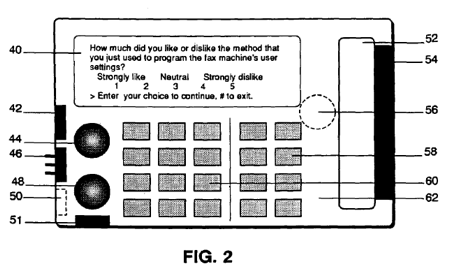
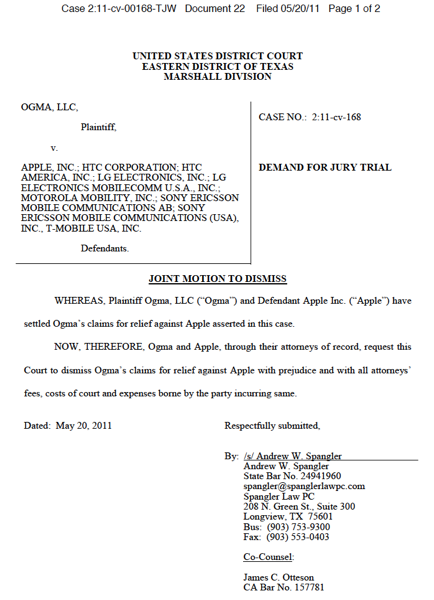
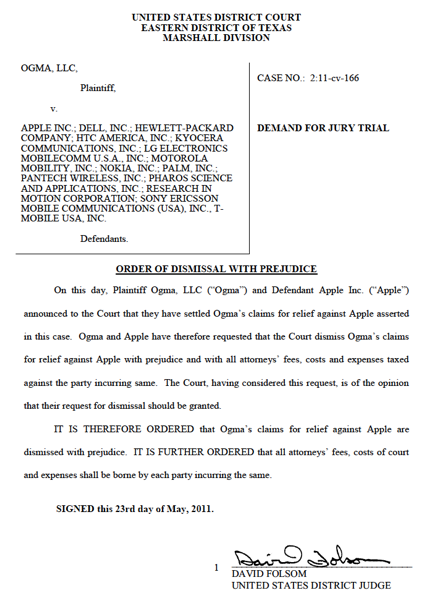
As anticipated after Apple no longer appeared as a respondent in the corresponding USITC matter, Apple has settled both cases filed against it by Ogma, LLC in the Eastern District of Texas.  One of the cases, 2:11-cv-168, involved the somewhat disturbing patent claims covering image displays based upon nothing more than their aspect ratios.

No information on settlement terms appears to have been announced.


Screen shot 2011 05 26 at 6 55 25 PM


Screen shot 2011 05 26 at 7 03 10 PM


Previous Coverage:

Monday, May 16, 2011

Ogma v. Activision, et al.: ITC Initiates Investigation, Apple Already Out.

The USITC announced on Friday, May 13, 2011 that it will institute an investigation based upon Ogma, LLC's complaint of infringement of its '947 sound effects and '427 screen aspect ratio patents against over thirty entities.

It appears that Apple was dropped as a respondent in the unpublished April 26, 2011 amended complaint, as it does not appear in the announcement of the investigation.  Seiko Epson, Epson, HTC, Motorola Mobility, Sanyo and Sharp also have disappeared.

Even with Apple no longer involved, I may still check in on this investigation periodically to see how the '427 fares against the prior art.  I suspect it will not do well.  The ITC case should also provide useful guidance for Apple in the still pending cases (2-11-cv-00166 and 2-11-cv-00168) in Marshall, TX, if Apple remains as a defendant.  Joint Motions to Dismiss the '947 cases against Motorola Mobility and RIM have already been filed and granted.


Previous Coverage:

Wednesday, April 20, 2011

Hybrid Audio v. HTC, Apple et al.

On April 19, 2011, Hybrid Audio LLC filed a Complaint for patent infringement in the Eastern District of Texas against HTC, Exedea, Apple, Dell, Motorola Mobility, Nokia, RIM, and Samsung (and associated corporate entities).  The case number is 6:11-cv-00195-LED.  Hybrid Audio is represented by McKool Smith.  My former colleague Daniel Carlineo is listed Of Counsel on the Corporate Disclosure Statement.  (Update: Carlineo is also listed as Manager of Hybrid Audio with the Texas SOS and handled the patent assignment.  See updates at the end of this post for more info.)

Plaintiff Hybrid Audio is a limited liability corporation organized and existing under the laws of Texas, with its principal place of business at 100 East Ferguson Street, Tyler, Texas 75702.

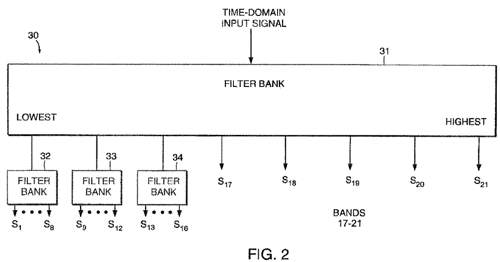
The patent at issue is United States Patent No. RE40,281 (“the ’281 Patent” or “the Patent”), entitled “Signal Processing Utilizing a Tree-Structured Array.”

The Complaint alleges that Apple infringes, contributes to infringement, and induces infringement via "the iPod nano, iPhone 4, iPad, MacBook Pro, and iTunes service that contain or use hardware and/or software for processing audio information in accordance with the MPEG-1 Layer III (MP3) standard." (Complaint, items 25-27)

The family history and reissue history of the patent are complex.  The November 23, 2004 amendment adds a paragraph to the reissue specification stating:

  • This application is a Division of U.S. Reissue Application No. 10/603,833 filed June 26,2003. U.S. Reissue Application No. 10/603,833, filed June 26, 2003, is a Reissue of U.S. Application No. 08/804,909, filed February 25, 1997, now U.S. Patent No. 6,252,909, issued June 26, 2001. U.S. Application No. 08/804,909, filed February 25, 1997, is a Continuation-In-Part of U.S. Application No. 08/307,331, filed September 16, 1994, now U.S. Patent No. 5,606,642, issued February 25, 1997. U.S. Application No. 08/307,331 filed September 16, 1994, is a Division of U.S. Application No. 07/948,147, filed September 21, 1992, now U.S. Patent No. 5,408,580, issued April 18, 1995.

The reissued patent lists 121 claims.  An initial amendment canceled claims 1-4 and added 5-112.  A subsequent amendment canceled 5-112 and added 113-229, which eventually issued as 5-121.  The file history also reveals that two of the inventors, Jayashima and Morrell, were non-signing relative to the reissue.

I suspect there will be quite a bit of investigation into the patent's lineage, particularly for support of the asserted claims.  It may be telling that only the reissue, and none of the other family members, are listed in the suit.

Claim 5, for reference:


5. A signal processing method comprising:

splitting a signal into subbands using a plurality of filter banks connected to form a tree-structured array having a root node and greater than two leaf nodes,

each node comprising one filter bank having greater than two filters, and at least one of the leaf nodes having a number of filters that differs from the number of filters in a second leaf node.


Screen shot 2011 04 20 at 1 40 50 PM


Update: I am reminded via FOSSPatents that Hybrid Audio LLC filed for voluntary dismissal without prejudice of its original suit (case no. 6:10-cv-00677) and filed this suit with a longer list of defendants.

Update 2:  The assignment of RE40281 from Aware, Inc. to Hybrid Audio, LLC was executed on 12/10/2010 and recorded 12/22/2010, with Carlineo, Spicer & Kee, LLC listed as Correspondent.

Update 3: Hybrid Audio's registered agent is listed as Terry Fokas, 2828 Hood St., Ste. 806, Dallas, TX 75219 USA.  Certificate of Formation was filed April 21, 2010.  Attorney Daniel Carlineo, mentioned above is listed as Manager.


Friday, April 8, 2011

Texas OCR Technologies v. Adobe, Apple, et al. Filed

On Friday, April 08, 2011, Texas OCR Technologies, L.L.C. filed a patent infringement complaint against defendants Adobe, Apple, Barnes & Noble, Microsoft, Google, and Nuance.  The case number is 6:11-cv-00175-LED (Judge Leonard Davis).

As in the previous case against Amazon (6:10-cv-00064-LED, filed 02/26/2010, later settled), Texas OCR asserted U.S. Patent No. 6,363,179, “Methodology for Displaying Search Results Using Character Recognition.”

Representative Patent Claim

1. A method of outputting search results, comprising the computer implemented steps of:

  • recognizing characters in a plurality of document images to produce respective document texts;
  • determining regions of the document images that correspond to words of the respective document texts;
  • receiving an input indicating one or more search terms;
  • retrieving a matching document text from among the document texts based on the one or more search terms, wherein the matching document text includes at least one matching word that matches one of the search terms;
  • displaying, in a first manner, a matching document image corresponding to the matching document text;
  • automatically determining a featured region based on the one or more search terms in the matching document image that includes a matching region in the matching document image corresponding to the matching word; and
  • automatically displaying the featured region in the matching document images in a second manner visually distinct from the first manner, wherein said second manner is not chosen by a user between said automatically determining step and said automatically displaying step.

Texas OCR Technologies, LLC

As in many EDTX cases, the plaintiff has a very short corporate history.

Texas OCR Technologies, LLC, was registered December 3, 2009, with address 140 E Tyler ST STE 220, Longview, TX 75601.  The Certificate of Formation was signed by Jason A. Holt, an attorney with Stevens, Love, Hill & Holt, PLLC.

The managing member is listed as STAR Co. Scientific Technologies Advanced Research Co., L.L.C., which in turn is managed by STAR Co. Investment Trust.  I was unable to locate information on STAR Co. Investment Trust.

Patent Assignments

The patent has changed hands a few times:

  • Just Systems Evans Research, Inc. to Texas OCR Technologies, LLC, executed 12/10/2009, recorded 02/08/2010.
  • Clairvoyance Corporation to Just Systems Evans Research, Inc., executed 03/16/2007, recorded 02/27/2008
  • Claritech Corporation to Clairvoyance Corporation, executed 6/21/2000, recorded 2/12/2008
  • Inventors to Claritech Corporation, executed 7/30/1997, recorded 01/11/1999